TETRA TECH
Success Story: The Power of a Customer-Focused Government
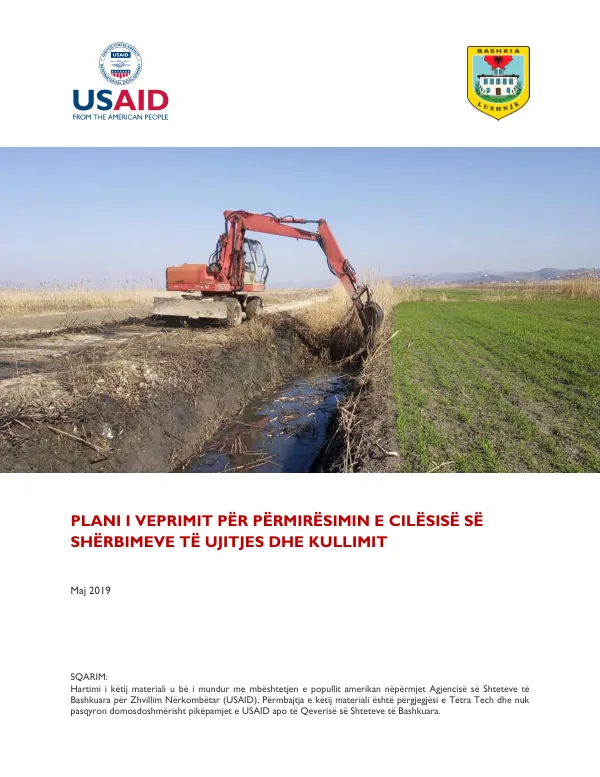
The Albanian government's water sector faces significant challenges, including problems with drainage that have resulted in catastrophic flooding.
2020 · 1 pages
Sign in to readA free account is required to download.
Abstract
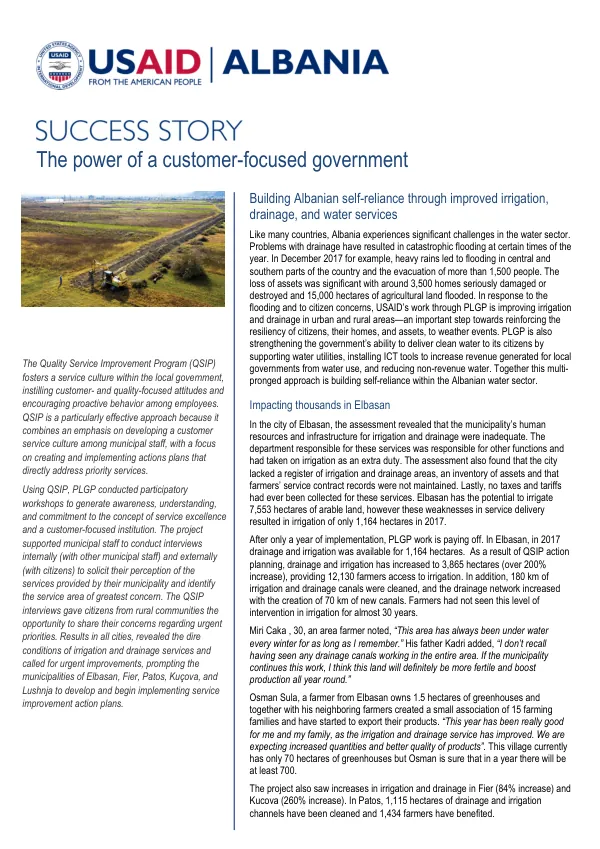
Heavy rains in December 2017 led to flooding in central and southern parts of the country, resulting in the evacuation of over 1,500 people, significant loss of assets, and 15,000 hectares of agricultural land flooded. In response to the flooding and citizen concerns, USAID's Power and Local Governance Program (PLGP) is improving irrigation and drainage in urban and rural areas to reinforce the resiliency of citizens, their homes, and assets to weather events. In the city of Elbasan, the municipality's human resources and infrastructure for irrigation and drainage were inadequate. The department responsible for these services was responsible for other functions and had taken on irrigation as an extra duty. The city lacked a register of irrigation and drainage areas, an inventory of assets, and maintained farmers' service contract records. Additionally, no taxes and tariffs had ever been collected for these services. Elbasan has the potential to irrigate 7,553 hectares of arable land, but weaknesses in service delivery resulted in irrigation of only 1,164 hectares in 2017. After one year of implementation, PLGP work is paying off. In Elbasan, drainage and irrigation was available for 1,164 hectares in 2017. Following Quality Service Improvement Program (QSIP) action planning, drainage and irrigation increased to 3,865 hectares (over 200% increase), providing 12,130 farmers access to irrigation. In addition, 180 km of irrigation and drainage canals were cleaned, and the drainage network increased with the creation of 70 km of new canals. Farmers had not seen this level of intervention in irrigation for almost 30 years. The project also saw increases in irrigation and drainage in Fier (84% increase) and Kucova (260% increase). In Patos, 1,115 hectares of drainage and irrigation channels have been cleaned, and 1,434 farmers have benefited. The QSIP approach combines an emphasis on developing a customer service culture among municipal staff with a focus on creating and implementing action plans that directly address priority services. QSIP conducted participatory workshops to generate awareness, understanding, and commitment to the concept of service excellence and a customer-focused institution. The QSIP interviews gave citizens from rural communities the opportunity to share their concerns regarding urgent priorities. Results in all cities revealed the dire conditions of irrigation and drainage services and called for urgent improvements, prompting the municipalities of Elbasan, Fier, Patos, Kuçova, and Lushnja to develop and begin implementing service improvement action plans. The project's focus on customer-focused government and service delivery has led to significant improvements in irrigation and drainage services, benefiting thousands of farmers and citizens in Albania.