USAID
Sudan BRIDGE FY10 Annual Report
The BRIDGE Program in Sudan is a comprehensive initiative aimed at strengthening the capacity of local government to deliver social services and promote economic growth.
2010 · 84 pages
Sign in to readA free account is required to download.
Abstract
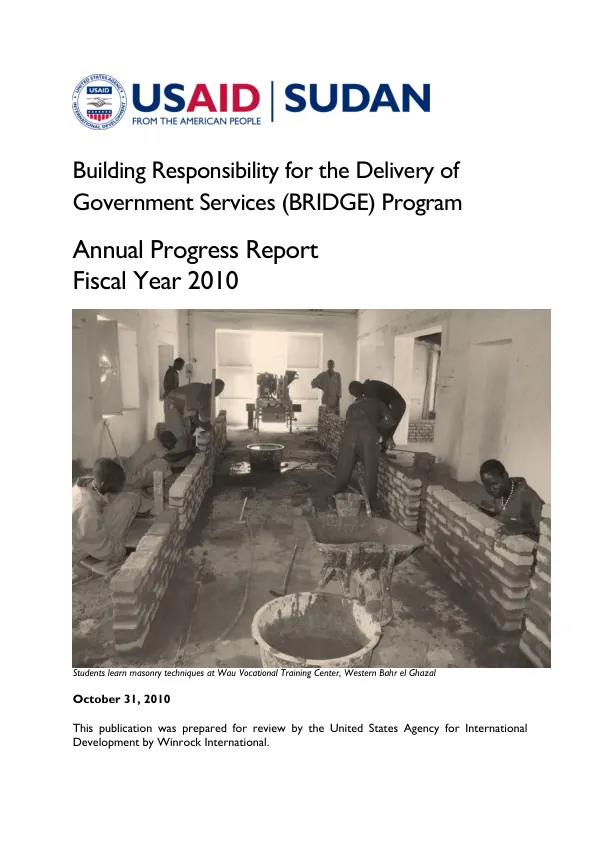
The program is implemented in five components, each focusing on a specific area of development. Component 1, Strengthen the Capacity of Local Government, involves improving state and local government capacity in selected functional areas, cross-sectoral planning and budgeting, and deepening the culture of democracy. Task 1.1 aims to improve state and local government capacity in areas such as finance, human resources, and procurement, while Task 1.2 focuses on improving cross-sectoral planning and budgeting to ensure effective allocation of resources. Task 1.3 seeks to deepen the culture of democracy by promoting transparency, accountability, and participation in local governance. Component 2, Strengthen the Capacity of Communities and Government, focuses on facilitating the development of community organizations that are democratic and effective in promoting community well-being. Task 2.1 involves facilitating the development of community organizations, while Task 2.2 strengthens the quality of interaction between communities and local government. Task 2.3 aims to improve community well-being through support for micro-projects that address specific community needs. The program also supports the development of community action groups, which foster local ownership and empower leaders. Component 3, Increase Food Security and Promote Rapid, Broad-Based, and Self-Sustaining Economic Growth, focuses on developing the agriculture, fisheries, livestock, and non-timber forest product sectors. Task 3.1 strengthens government capacity to support these sectors, while Task 3.2 builds civil society capacity that underpins vibrant agriculture, livestock, and NTFP sectors. Task 3.3 aims to increase crop production, while Task 3.4 improves the profitability of livestock and fishing in Unity State. Task 3.5 strengthens the commercial viability of enterprises along the agriculture and livestock value chains. Component 4, Increase Access to Safe Water and Sanitation, focuses on building government capacity to deliver improved water and sanitation services. Task 4.1 involves building government capacity, while Task 4.2 builds community and government capacity to collaborate in the planning, building, operation, and maintenance of water and sanitation systems. Task 4.3 aims to strengthen private sector involvement in the provision of water and sanitation services. Component 5, Expand Access to Quality Education, focuses on strengthening government capacity to improve access to quality education. Task 5.1 involves strengthening government capacity, while Task 5.2 strengthens community governance mechanisms and their ability to work in constructive ways with local officials. Task 5.3 aims to increase literacy rates in target areas. The BRIDGE Program has made significant progress in achieving its objectives, with notable successes in areas such as community organization development, capacity building, and infrastructure development. The program has also promoted gender equity and environmental compliance, and has made significant strides in improving access to quality education and increasing food security.