USAID DEC
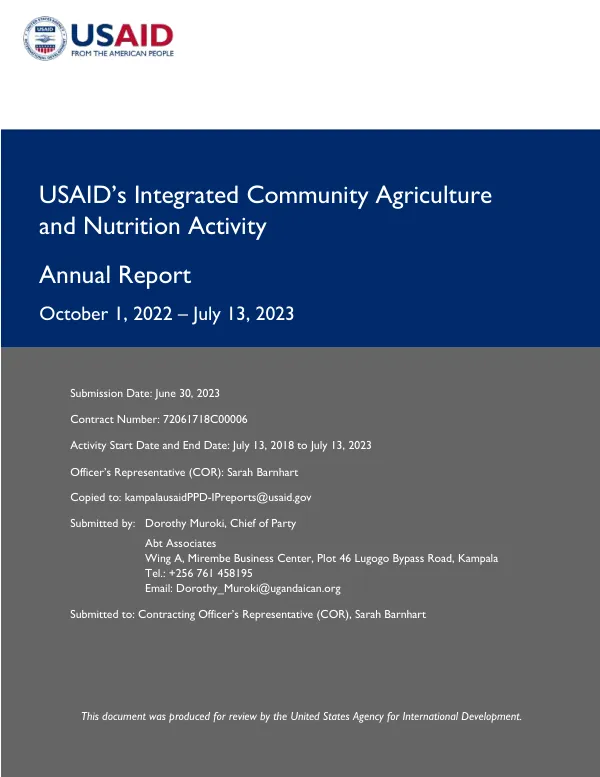
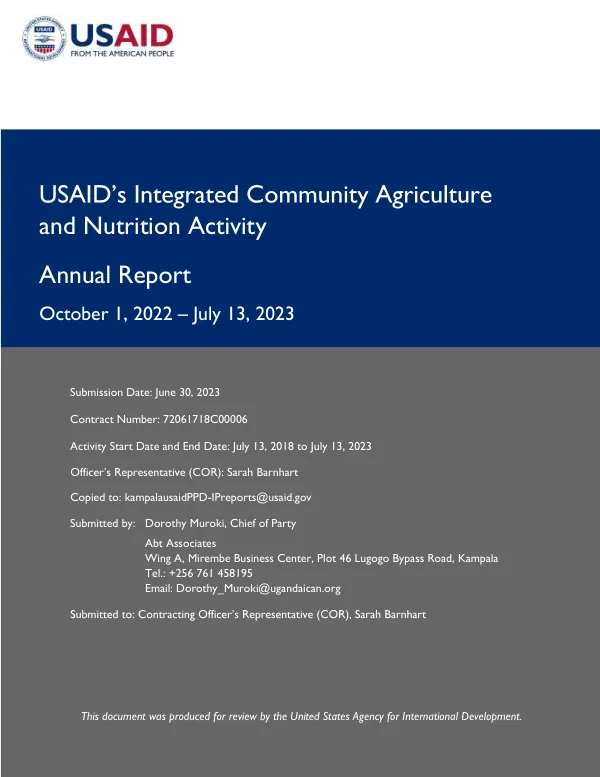
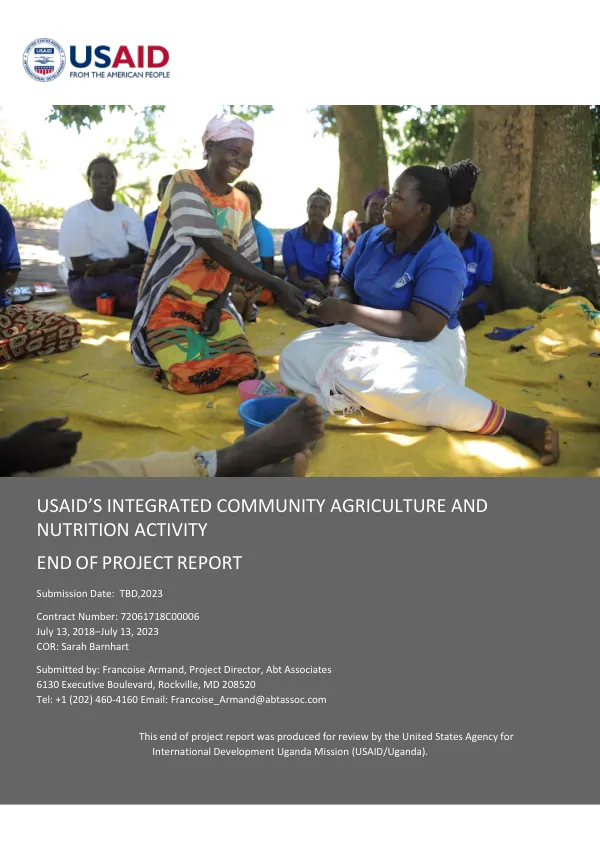
USAID’s Integrated Community Agriculture and Nutrition Activity End of Project Report
Sign inABT ASSOCIATES
USAID’s Integrated Community Agriculture and Nutrition Activity End of Project Report
The USAID Integrated Community Agriculture and Nutrition Activity (USAID ICAN) was a community-level resilience program implemented in eight districts of Uganda.
2023 · 72 pages
Sign in to readA free account is required to download.
Abstract
The Activity focused on improving incomes, nutrition, and food security, as well as water and sanitation, governance, school enrollment and retention, and natural resource management. Since 2018, USAID ICAN has reached 248,574 participants through various activities. The Activity was designed to be localized and multi-sector, with a focus on community-led interventions. USAID ICAN worked closely with local implementing partners, line ministries, institutions, the private sector, and civil society to achieve its objectives. Community structures, including village health teams, business service providers, governance champions, patrons/matrons, and cultural leaders, played a crucial role in the Activity's implementation. One of the key aspects of the Activity was its focus on addressing gender and power imbalances that hinder women and youth's economic opportunities and ability to influence their communities. USAID ICAN worked with partners to motivate local actors to support inclusive resilience actions across sectors, with the goal of increasing the likelihood that activities would be sustained after the Activity ended. The Activity's approach was centered on embedding actions within existing community structures, which helped to increase the likelihood of sustainability. By working with local actors and community structures, USAID ICAN was able to leverage existing networks and relationships to achieve its objectives. The Activity's impact was significant, with 248,574 participants reached through various activities. The Activity's focus on community-led interventions and inclusive resilience actions helped to improve incomes, nutrition, and food security, as well as water and sanitation, governance, school enrollment and retention, and natural resource management. USAID ICAN's approach to community-led development and inclusive resilience actions has provided valuable lessons for future development initiatives. The Activity's focus on addressing gender and power imbalances and leveraging existing community structures has helped to increase the likelihood of sustainability and long-term impact. The Activity's success can be attributed to its localized and multi-sector approach, which allowed it to address the complex needs of the communities it served. By working closely with local partners and community structures, USAID ICAN was able to achieve its objectives and make a lasting impact on the lives of the people it served. The Activity's impact on the communities it served was significant, with improvements in incomes, nutrition, and food security, as well as water and sanitation, governance, school enrollment and retention, and natural resource management. The Activity's focus on inclusive resilience actions and community-led development has provided a model for future development initiatives, highlighting the importance of working closely with local partners and community structures to achieve long-term impact. The Activity's success has also been recognized through various indicators, including the number of participants reached, the number of households that have improved their incomes, and the number of communities that have improved their access to water and sanitation. The Activity's impact on the communities it served has been significant, and its approach to community-led development and inclusive resilience actions has provided valuable lessons for future development initiatives. The Activity's focus on addressing gender and power imbalances has also been recognized as a key factor in its success. By working with partners to motivate local actors to support inclusive resilience actions across sectors, USAID ICAN was able to increase the likelihood that activities would be sustained after the Activity ended. This approach has provided a model for future development initiatives, highlighting the importance of addressing gender and power imbalances in community-led development. The Activity's success has also been recognized through various awards and recognition, including the USAID Excellence in Development Award. This award recognizes outstanding achievements in development programming, and USAID ICAN's success in improving incomes, nutrition, and food security, as well as water and sanitation, governance, school enrollment and retention, and natural resource management, has made it a standout example of effective development programming. Overall, the USAID Integrated Community Agriculture and Nutrition Activity (USAID ICAN) has been a highly successful program that has made a lasting impact on the lives of the people it served. Its approach to community-led development and inclusive resilience actions has provided valuable lessons for future development initiatives, and its focus on addressing gender and power imbalances has been recognized as a key factor in its success.
Related documents