THE WORLD FOOD PROGRAMME
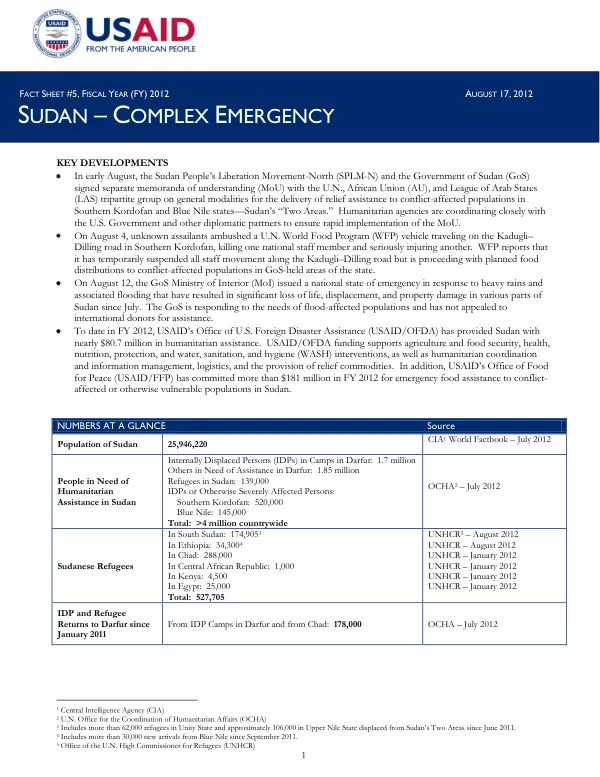
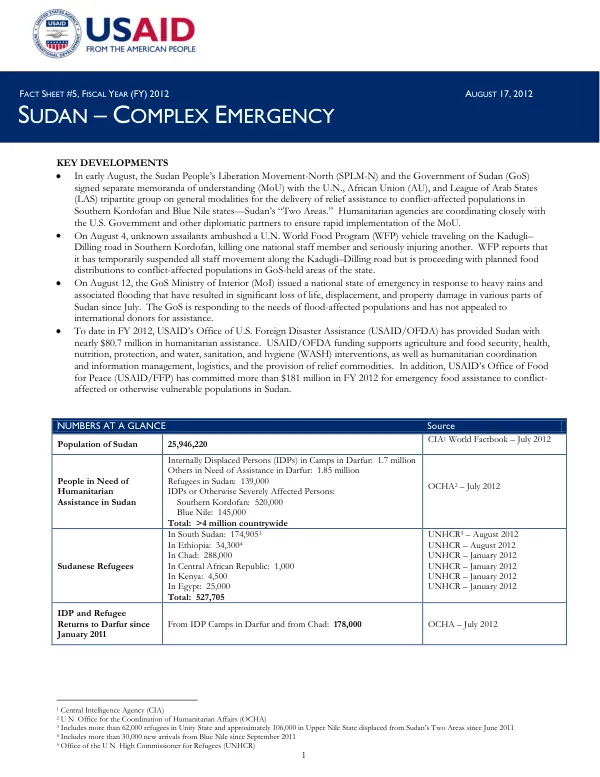
Sudan – Complex Emergency Fact Sheet #5, Fiscal Year (FY) 2012
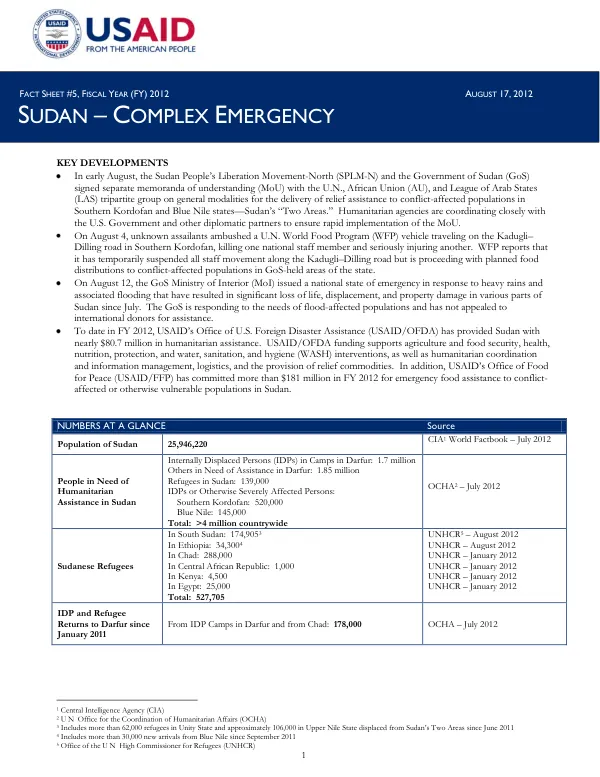
The Sudan People's Liberation Movement-North (SPLM-N) and the Government of Sudan (GoS) signed separate memoranda of understanding (MoU) with the U.N., African Union (AU), and League of Arab States (LAS) tripartite group on general modalities for the delivery of relief assistance to conflict-affected populations in Southern Kordofan and Blue Nile states.
2012 · 8 pages
Sign in to readA free account is required to download.
Abstract
Humanitarian agencies are coordinating closely with the U.S. Government and other diplomatic partners to ensure rapid implementation of the MoU. On August 4, a U.N. World Food Program (WFP) vehicle was ambushed in Southern Kordofan, resulting in the death of one national staff member and serious injury to another. The WFP has temporarily suspended all staff movement along the Kadugli-Dilling road but is proceeding with planned food distributions to conflict-affected populations in GoS-held areas of the state. The GoS Ministry of Interior (MoI) issued a national state of emergency in response to heavy rains and associated flooding that have resulted in significant loss of life, displacement, and property damage in various parts of Sudan since July. The GoS is responding to the needs of flood-affected populations and has not appealed to international donors for assistance. To date in FY 2012, USAID's Office of U.S. Foreign Disaster Assistance (USAID/OFDA) has provided Sudan with nearly $80.7 million in humanitarian assistance. USAID/OFDA funding supports agriculture and food security, health, nutrition, protection, and water, sanitation, and hygiene (WASH) interventions, as well as humanitarian coordination and information management, logistics, and the provision of relief commodities. In addition, USAID's Office of Food for Peace (USAID/FFP) has committed more than $181 million in FY 2012 for emergency food assistance to conflict-affected or otherwise vulnerable populations in Sudan. The population of Sudan is approximately 25.9 million people, with more than 4 million individuals in need of humanitarian assistance. This includes 1.7 million internally displaced persons (IDPs) in camps in Darfur, 1.85 million others in need of assistance in Darfur, and 139,000 refugees in Sudan. The humanitarian situation in Sudan is complex, with ongoing conflict, economic shocks, and environmental hazards such as drought and flooding affecting the country. The GoS and the Liberation and Justice Movement (LJM), an armed opposition group in Darfur, signed the Doha Document for Peace in Darfur (DDPD) on July 14, 2011, a framework for establishing a comprehensive peace process in Darfur. The Comprehensive Peace Agreement (CPA) between the GoS and the southern-based Sudan People's Liberation Movement officially ended more than two decades of North-South conflict in 2005. The CPA led to the independence of the Republic of South Sudan on July 9, 2011. Heavy rains and associated flooding have affected more than 30 people, displaced or otherwise affected up to 80,000 others, and caused significant property damage across Sudan since July. The GoS reports that it is providing emergency relief and shelter supplies to flood-affected populations across Sudan. The Sudanese Red Crescent Society (SRCS) is assisting with population relocation to safer areas and has provided relief assistance to more than 9,000 flood-affected individuals as of August 14. Clashes between the SAF and SPLM-N in areas of Southern Kordofan and Blue Nile continue to affect civilians and cause displacement. Humanitarian organizations estimate that fighting that began in Southern Kordofan and Blue Nile in June 2011 and September 2011, respectively, has affected approximately 870,000 people to date, including 665,000 individuals internally displaced or otherwise severely affected within the Two Areas.
Related documents