INTERNATIONAL CHILDREN'S FUND, INC.
USG Syria Complex Emergency Fact Sheet #3 - FY 2013
The conflict in Syria began in March 2011 with peaceful demonstrations against the Syrian government, which were met with violence from government forces.
2013 · 6 pages
Sign in to readA free account is required to download.
Abstract
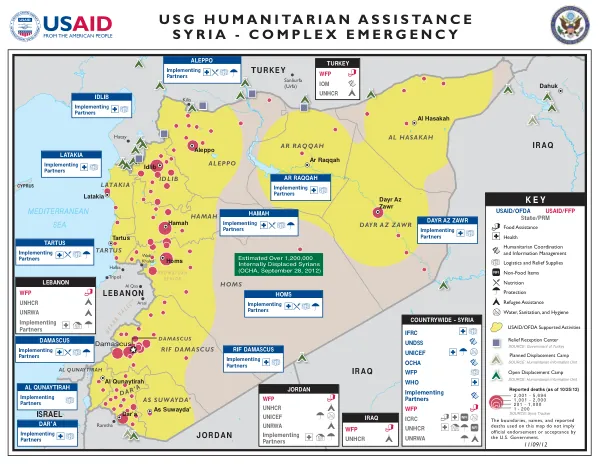
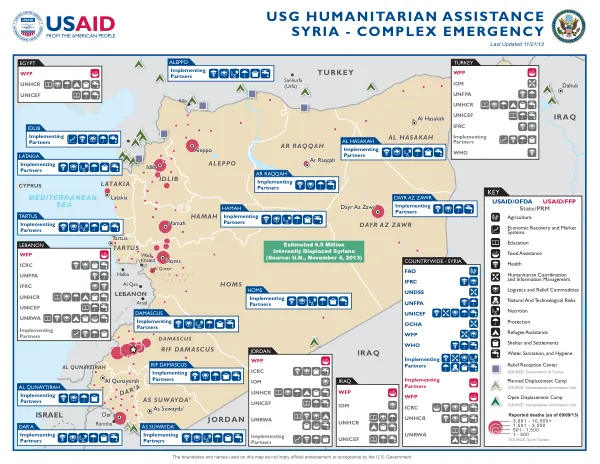
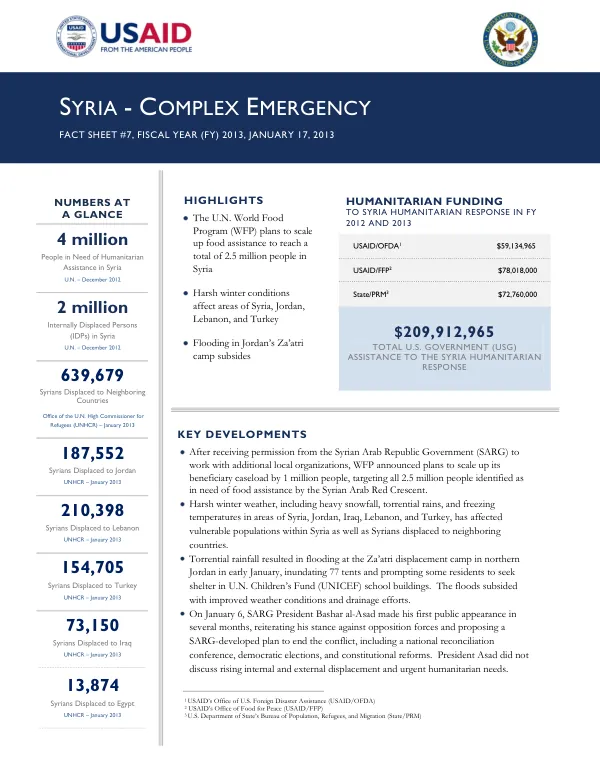
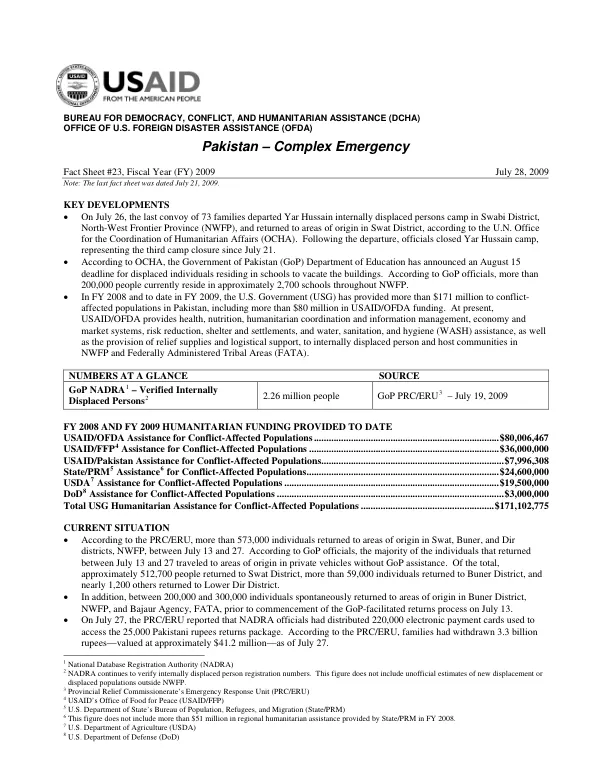
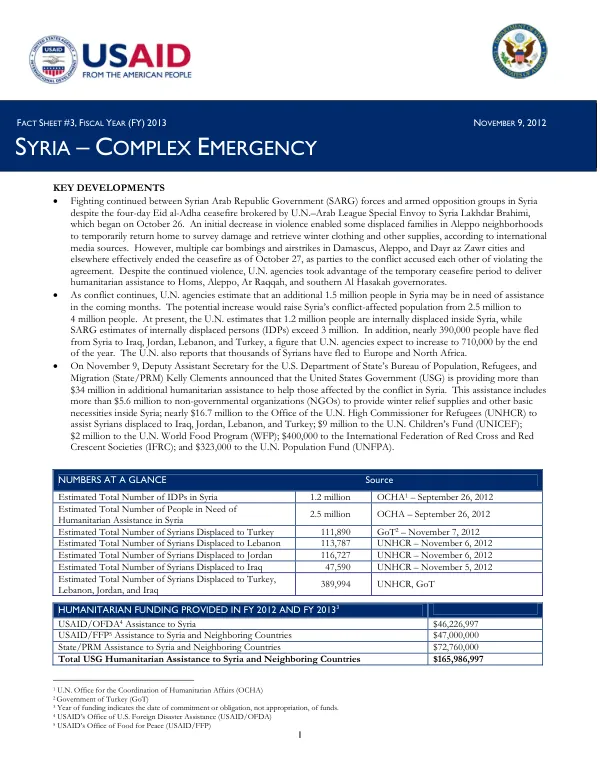
President Bashar al-Assad's pledge for legislative reforms failed to materialize, and the conflict escalated, leading to the deaths of over 36,000 people, including civilians, armed insurgents, defectors, and members of the Syrian Arab Republic Government (SARG) security forces. The SARG accepted a six-point peace plan proposed by U.N.–Arab League Special Envoy to Syria Kofi Annan in March 2012, which called for a ceasefire, unrestricted humanitarian access, and the withdrawal of military personnel from populated areas. However, the ceasefire never took full effect as clashes between SARG and opposition forces continued. Lakhdar Brahimi became U.N.–Arab League Special Envoy to Syria in September, replacing Kofi Annan. The conflict has resulted in significant population displacement, with approximately 1.2 million people internally displaced inside Syria. Many of these individuals are residing with host families and in public buildings, including over 2,100 schools that have been converted into displacement sites. U.N. agencies and other humanitarian organizations are rehabilitating these buildings to improve sanitation conditions and suitability for winter accommodation. Syria's Ar Raqqah Governorate has received a high number of internally displaced persons (IDPs) from Aleppo and Dayr az Zawr governorates due to ongoing fighting in those areas. As of October 26, approximately 300,000 IDPs had registered for assistance in Ar Raqqah, with local officials estimating that up to 500,000 IDPs are residing in the governorate. Many of these IDPs are residing with host families, placing a strain on community coping mechanisms. In addition to internal displacement, the conflict has also resulted in a significant number of refugees fleeing Syria to neighboring countries. As of November 7, approximately 111,890 displaced Syrians resided in camps in Turkey, with up to 70,000 living outside of the camps. In Jordan, UNHCR and other international and local humanitarian organizations are assisting people who have fled from Syria and are residing in Za'atri camp or in Jordanian host communities. The number of Syrians displaced to Jordan is expected to increase, with over 116,727 already registered with UNHCR. The conflict has also had a significant impact on Palestinian refugees in Syria, with over 225,000 affected by the conflict. UNRWA estimates that as many as three-quarters of Palestinian refugees may need help to meet their food and other essential living needs. Approximately 8,000 Palestinian refugees from Syria have entered Lebanon and sought UNRWA assistance, while more than 1,600 have entered Jordan. In Syria, UNRWA has highlighted the negative impact of the conflict on Palestinian refugee communities near Damascus, where tension and violence have escalated in recent weeks. The U.S. Department of State's Bureau of Population, Refugees, and Migration (State/PRM) has announced that the United States Government (USG) is providing more than $34 million in additional humanitarian assistance to help those affected by the conflict in Syria. This assistance includes more than $5.6 million to non-governmental organizations (NGOs) to provide winter relief supplies and other basic necessities inside Syria; nearly $16.7 million to the Office of the U.N. High Commissioner for Refugees (UNHCR) to assist Syrians displaced to Iraq, Jordan, Lebanon, and Turkey; $9 million to the U.N. Children's Fund (UNICEF); $2 million to the U.N. World Food Program (WFP); $400,000 to the International Federation of Red Cross and Red Crescent Societies (IFRC); and $323,000 to the U.N. Population Fund (UNFPA).