FAO
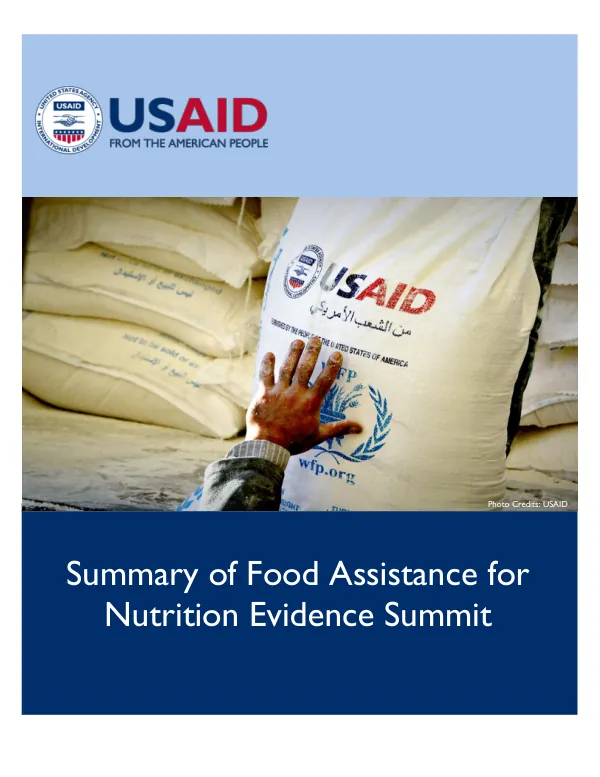
Summary of Food Assistance for Nutrition Evidence Summit
The Food Assistance for Nutrition Evidence Summit was organized by the Food Aid Quality Review (FAQR) project and USAID's Office of Food for Peace (FFP) in Washington D.C.
2018 · 30 pages
Sign in to readA free account is required to download.
Abstract
on June 27th and 28th, 2018. The 2-day event brought together over 250 researchers, policy makers, and representatives from donors, industry, and implementing partners to share evidence relevant to policy and programmatic decision-making, and identify critical evidence gaps. Humanitarian needs are on the rise, with more than 800 million people experiencing chronic hunger and a projected 76 million people in 45 countries requiring emergency food assistance in 2018. The re-emergence of famine, the scale of ongoing humanitarian crises, and continuing intractable malnutrition around the world significantly strain the ability to address the needs of the world's most vulnerable. To achieve impact at scale, there must be an understanding of the most cost-effective options. The Evidence Summit consisted of presentations, panels, lightning talks, demonstrations, discussions, and poster/table displays covering various topics, including current evidence on food assistance programming that has maternal and child nutrition or micronutrient deficiencies as explicit outcomes of interest, future needs for assistance on development of nutritionally-enhanced products and programming, and optimizing resource allocations. Priority actions were identified to support the Sustainable Development Goals (SDGs) and address the needs of the world's most vulnerable. These actions include increasing the use of evidence-based programming, improving the quality and safety of food aid, and optimizing the food aid supply chain. Additionally, there is a need to develop nutritionally-enhanced products and programming, and to conduct cost-effectiveness research to inform policy and programmatic decisions. The summit also highlighted the importance of innovations in packaging, ingredients, formulations, and processing of food aid products, as well as research methods and metrics to determine nutrition impacts, cost-effective operations, and additional ancillary goals. Food aid safety and quality were also emphasized as critical components of effective food assistance programming. The summit brought together a diverse group of stakeholders to share evidence and identify critical evidence gaps. The outcomes of the summit will inform policy and programmatic decisions, and contribute to the development of more effective and efficient food assistance programs.