IMPAQ INTERNATIONAL, LLC
Education for a Just Society: Evaluation Report
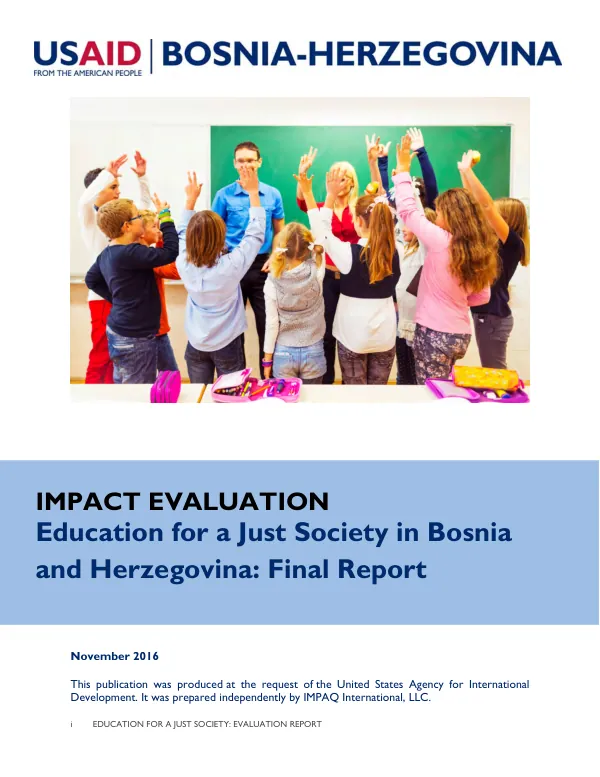
The Education for a Just Society initiative in Bosnia and Herzegovina aimed to change the educational system through a holistic approach.
2016 · 37 pages
Sign in to readA free account is required to download.
Abstract
The project, implemented by the United States Agency for International Development (USAID)/BiH, Center for Education Initiatives Step by Step (CEI), and proMENTE, with co-funding from Open Society Fund BiH, focused on educating BiH youths to bring about sustainable peace, feelings of reconciliation, and cohesion on a societal level. The education system in Bosnia and Herzegovina continues to discriminate against children based on their ethnic, religious, political, and economic backgrounds. Structural issues contributing to this discrimination include the operation of "two schools under one roof," the policy of "quiet assimilation" by minority children, and the creation of mono-ethnic schools. Separate curricula and textbooks in BiH lead to language segregation, ethnocentricity, and do not promote a sense of belonging or understanding of a common BiH identity. The Education for a Just Society activity aimed to address these issues through three essential components. Firstly, the activity created a safe space for students to interact and learn from children of different ethnicities and religions. This was achieved through extracurricular activities that brought together students from different backgrounds. Secondly, the activity worked with teachers to increase their competencies in critical thinking strategies and their leadership in changing the education system. This involved training teachers in critical thinking and leadership skills to empower them to become leaders in their schools and communities. The project's evaluation report presents the findings of an impact evaluation conducted in 2016. The evaluation aimed to assess the impact of the Education for a Just Society activity on students' interactions, attitudes, and perceptions towards children of different ethnicities and religions. The evaluation design and data collection involved a comparison of treatment and comparison groups, with the treatment group consisting of students who participated in the extracurricular activities and the comparison group consisting of students who did not participate. The evaluation found that students who participated in the extracurricular activities showed significant improvements in their interactions, attitudes, and perceptions towards children of different ethnicities and religions. Specifically, the evaluation found that students who participated in the extracurricular activities were more likely to interact with children of different ethnicities and religions, had more positive attitudes towards children of different ethnicities and religions, and perceived their teachers as playing a more important role in building trust and partnership among children of different ethnicities and religions. The evaluation also found that students who actively participated in the extracurricular activities showed greater impacts than those who did not actively participate. The evaluation estimated that the activity-funded extracurricular activities had a positive impact on students' interactions, attitudes, and perceptions towards children of different ethnicities and religions, with the greatest impacts observed in students who actively participated in the extracurricular activities. Overall, the Education for a Just Society initiative in Bosnia and Herzegovina aimed to change the educational system through a holistic approach, focusing on creating a safe space for students to interact and learn from children of different ethnicities and religions, working with teachers to increase their competencies in critical thinking strategies and leadership, and empowering students and teachers to become leaders in their schools and communities. The evaluation report presents the findings of an impact evaluation conducted in 2016, which found significant improvements in students' interactions, attitudes, and perceptions towards children of different ethnicities and religions.