USAID DEC
Supply Chain Management for Integrated Community Case Management
Integrated Community Case Management (iCCM) programs rely on a well-functioning supply chain to ensure the constant availability of essential health products.
2014 · 1 pages
Sign in to readA free account is required to download.
Abstract
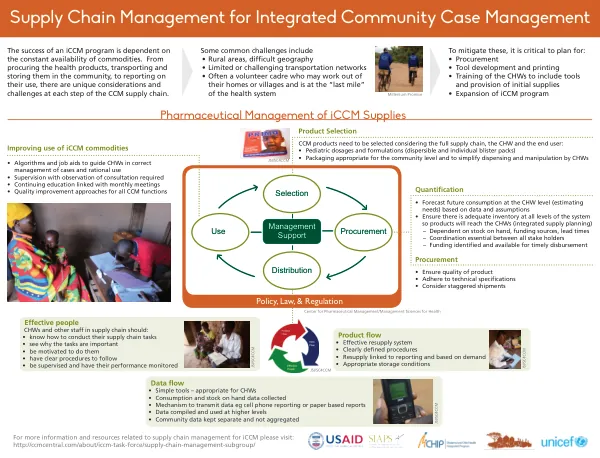
This includes procuring, transporting, and storing commodities, as well as reporting on their use. Each step of the CCM supply chain presents unique challenges, necessitating careful planning to mitigate these issues. Key considerations for the success of an iCCM program include procurement, tool development and printing, training of Community Health Workers (CHWs), and provision of initial supplies. Additionally, algorithms and job aids must be developed to guide CHWs in managing cases and managing cases and rational use of commodities. Regular supervision, linked with monthly meetings, is also essential to ensure quality improvement approaches are implemented across all CCM functions. When selecting CCM products, the full supply chain, the CHW, and the end user must be considered. This involves choosing products with suitable dosages and formulations, packaging that is appropriate for community-level use, and simplifying dispensing and manipulation by CHWs. Quantification of future consumption at the CHW level is also crucial, based on data and estimates, to ensure adequate inventory at all levels of the system. Effective supply chain management requires careful planning and coordination among all stakeholders, including stakeholders, including funding sources, and ensuring that funding is identified and available for disbursement. The quality of products must be ensured, and technical specifications must be adhered to. A resupply system with simple tools, consumption and stock on hand data collection, and a mechanism to transmit data must be established. CHWs and other staff in the supply chain must be trained to conduct their supply chain tasks, understand the importance of these tasks, and have clear procedures to follow. They must also be supervised and have their performance monitored. Effective people management is critical to the success of the iCCM program. Rural areas, limited transportation networks, and volunteer cadres working at the "last mile_ of the health system present common challenges to supply chain management. Addressing these challenges requires careful planning, coordination, and coordination among all stakeholders. The iCCM Task Force's Supply Chain Management Subgroup provides resources and information on supply chain management for iCCM. The Center for Pharmaceutical Management/Management Sciences for Health also offers guidance on improving use of iCCM commodities.