USAID DEC
Support for International Family Planning Organizations (SIFPO) End of Project Meeting
Sign inMARIE STOPES INTERNATIONAL
Support for International Family Planning Organizations (SIFPO) End of Project Meeting
The Support for International Family Planning Organizations (SIFPO) projects were five-year global cooperative agreements (2010-2015) designed to increase access to and utilization of voluntary, high-quality family planning (FP) services around the world.
2015 · 18 pages
Sign in to readA free account is required to download.
Abstract
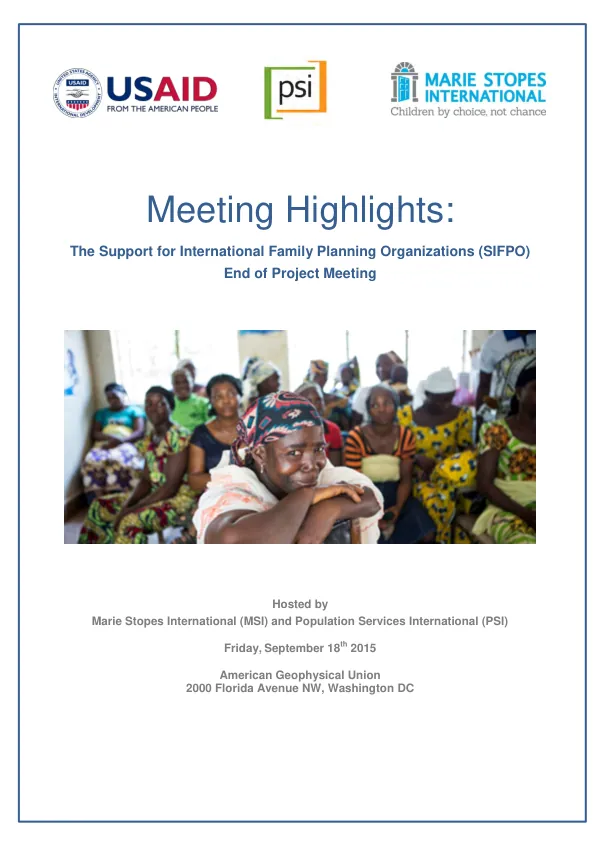
Marie Stopes International (MSI) and Population Services International (PSI) were awarded two SIFPO projects, which supported high-quality FP programming while strengthening organizational capacity and local leadership to support sustained contribution to FP 2020 goals. Through core support and Mission buy-ins, SIFPO-MSI and SIFPO-PSI enabled the two organizations to significantly scale up service delivery to expand FP access and choice, reaching millions of women and couples. The work conducted under SIFPO supported MSI and PSI to raise the quality of FP delivered through the private sector, strengthening the FP workforce through the refinement of operational models and support tools and training and support to thousands of private sector providers. Key themes emerged from the end of project meeting, including the scale-up, quality, and role of the private sector in achieving universal health coverage (UHC). The SIFPO-MSI and SIFPO-PSI projects demonstrated the role that the private sector can play in increasing FP access and choice as part of a total market approach. Evidence-based service delivery was also a key focus area, with SIFPO enabling MSI and PSI to strengthen and expand key evidence-based service delivery channels and to ensure responsiveness to changing client and health system needs. Country and regional staff capacity was also strengthened through targeted investments under SIFPO-MSI and SIFPO-PSI, resulting in increases in country and regional staff capacity to lead and implement evidence-based, client-centred FP programming. The SIFPO activities and results moved the entire FP sector forward through key initiatives, including testing, documentation, and scale-up of dedicated provider, mobile outreach, and social franchise models. The future of FP will focus on strengthening private sector channels for FP service delivery and better integrating the private sector into health systems in areas such as health financing, quality assurance, improved monitoring and reporting, and cost recovery. The end of project meeting brought together voices from a range of SIFPO stakeholders, including service providers and in-country administrators from Ghana and Guatemala, CEOs from both MSI and PSI, and senior leadership of USAID's Office of Population and Reproductive Health. Esther Worae, a midwife from MSI Ghana, shared the impact of SIFPO on MSI Ghana's work with the Kayayei, vulnerable migrant young women and girls working in Accra marketplaces. Silvia Consuelo Juarez, Director of the San Marcos Health Area in Guatemala, discussed the value of the partnership with PSI/PASMO under SIFPO and its lasting impact on motivation, training, and personal development for public sector providers. Ellen Starbird, Director of the Office of Population and Reproductive Health at USAID, highlighted the goals shared by FP2020, USAID's Office of Population and Reproductive Health, and the wider global FP community to reach 220 million women with unmet need for contraception. She described what SIFPO has meant for USAID and highlighted the principles that SIFPO embodies for USAID, including results, choice, innovation, quality, sustainability, and partnership. Karl Hofmann, CEO of PSI, spoke enthusiastically about SIFPO's catalytic effect on PSI and its capacity to contribute to global health impact. This includes institutional changes that allowed PSI to standardize, improve, and create local ownership of its rigorous quality assurance system, expand and improve its social franchising model, and expand contraceptive options for women and youth. SIFPO also allowed PSI to invest in the next generation of family planning leaders through intensive, practical technical and leadership training for its host country staff. Simon Cooke, CEO of MSI, emphasized the importance of SIFPO in strengthening MSI's systems and human resources capacity to leverage future impact. He highlighted the impact of SIFPO on MSI's work, including the expansion of FP services provided through social franchise clinics, accounting for nearly 11 million CYPs in 2014.
Related documents