USAID DEC
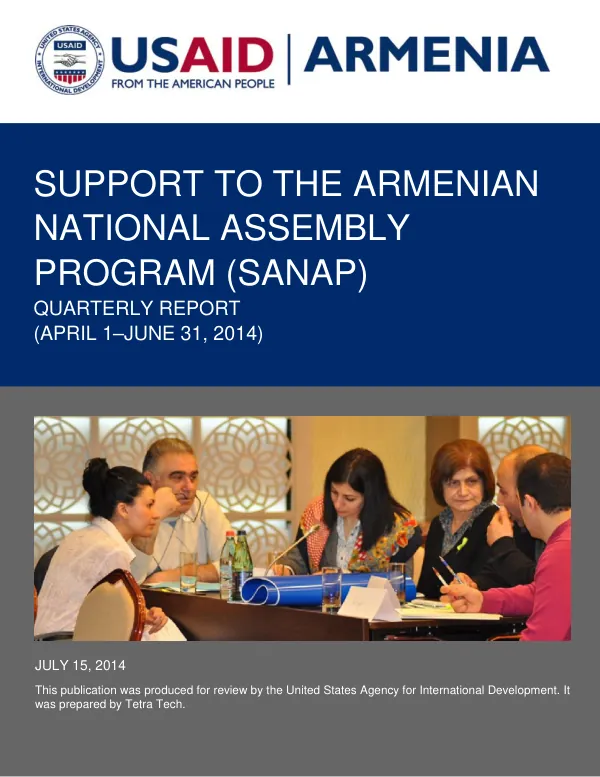
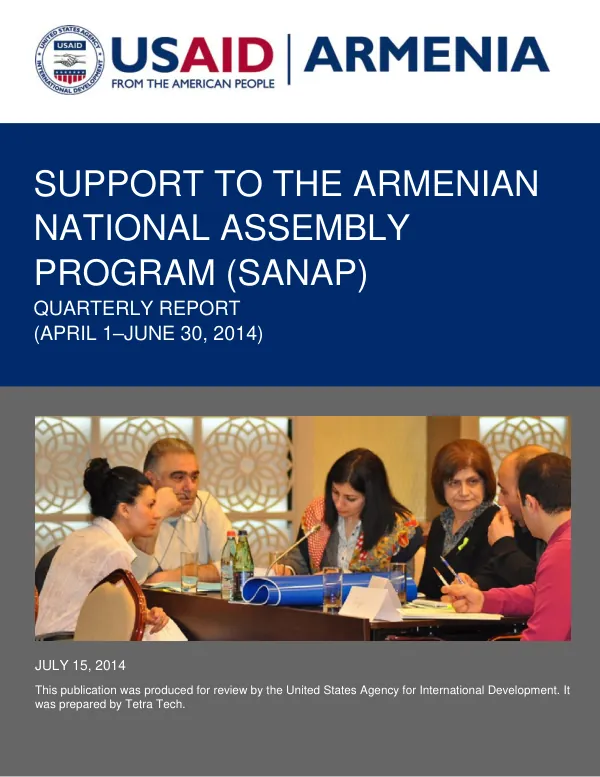
Support to the Armenian National Assembly Program (SANAP) Quarterly Report (April 1–June 30, 2014)
Sign inTETRA TECH
Support to the Armenian National Assembly Program (SANAP) Quarterly Report (April 1–June 30, 2014)
The Support to the Armenian National Assembly Program (SANAP) is a four-year initiative funded by the United States Agency for International Development (USAID).
2014 · 97 pages
Sign in to readA free account is required to download.
Abstract
The program aims to strengthen the National Assembly's institutional capacity by achieving four objectives: increasing the representation of citizens' interests, improving oversight of the executive branch, enhancing the analytical capacity of selected committees, and clarifying rules and procedures governing selected committees. SANAP works with selected committees to build their capacity by strengthening the skills and knowledge of committee Members of Parliament (MPs), enhancing rules and procedures, improving legislative analysis, and expanding outreach to citizens and civil society. The program also works with individual MPs elected from single-member districts who want to strengthen constituent links and supports other USAID projects that have issues requiring parliament consideration. During the first year of the project, SANAP worked with five standing committees: Financial - Credit and Budgetary Affairs, Protection of Human Rights and Public Affairs, State and Legal Affairs, Territorial Affairs and Local Self Government, and Ethics. Beginning October 2014, SANAP began working with three additional committees: Healthcare, Maternity and Childhood, Agriculture and Environment, and Economic Affairs. The program's work is guided by a Memorandum of Understanding (MOU) between Tetra Tech and USAID. SANAP is led by a Chief of Party (COP) and a Deputy Chief of Party (DCOP), who are responsible for overseeing the program's implementation. The program's budget is $4,269,138, and it is expected to be completed by the end of 2016. During the quarter covered by this report, there were significant leadership changes in top government positions, which directly affected SANAP. On April 3, Armenia's constitutional court ruled that the country's controversial pension legislation violated the law. On April 4, the Prime Minister announced his resignation, and on April 13, the Speaker of Parliament resigned to become Prime Minister. SANAP's activities during the quarter included supporting legislative initiatives, strengthening budget oversight and legislative oversight, improving parliament hearings and expanding committee outreach, institutionalizing hearing improvements through a parliament hearing manual, expanding civil society engagement, and supporting professional development. The program also conducted midterm evaluations and assessments to measure its progress and identify areas for improvement. The program's progress and challenges during the quarter are summarized in the following sections. The Representation of Citizens' Interests objective was advanced through the support of legislative initiatives, while the Oversight of the Executive Branch objective was advanced through the strengthening of budget oversight and legislative oversight. The Analytical Capacity of Selected Committees objective was advanced through the improvement of parliament hearings and the expansion of committee outreach. The Rules and Procedures governing Selected Committees objective was advanced through the institutionalization of hearing improvements and the expansion of civil society engagement. SANAP's activities during the quarter were carried out in collaboration with various stakeholders, including the National Assembly, the government, civil society organizations, and international partners. The program's progress and challenges during the quarter are summarized in the following sections. The Representation of Citizens' Interests objective was advanced through the support of legislative initiatives, including the development of a draft law on the protection of human rights. The program also supported the establishment of a parliamentary committee on human rights, which is responsible for monitoring the implementation of human rights laws and policies. The Oversight of the Executive Branch objective was advanced through the strengthening of budget oversight and legislative oversight. The program supported the development of a budget oversight manual, which provides guidance on the budget oversight process. The program also supported the establishment of a parliamentary committee on budget oversight, which is responsible for monitoring the implementation of the budget. The Analytical Capacity of Selected Committees objective was advanced through the improvement of parliament hearings and the expansion of committee outreach. The program supported the development of a parliament hearing manual, which provides guidance on the hearing process. The program also supported the establishment of a parliamentary committee on analytical capacity, which is responsible for improving the analytical capacity of selected committees. The Rules and Procedures governing Selected Committees objective was advanced through the institutionalization of hearing improvements and the expansion of civil society engagement. The program supported the development of a rules and procedures manual, which provides guidance on the rules and procedures governing selected committees. The program also supported the establishment of a parliamentary committee on rules and procedures, which is responsible for monitoring the implementation of the rules and procedures. The program's progress during the quarter was significant, with advances made in all four objectives. However, the program also faced challenges, including the impact of leadership changes in top government positions and the need to adapt to changing circumstances. Despite these challenges, the program remains committed to its objectives and is working to overcome the challenges and achieve its goals.