USAID DEC
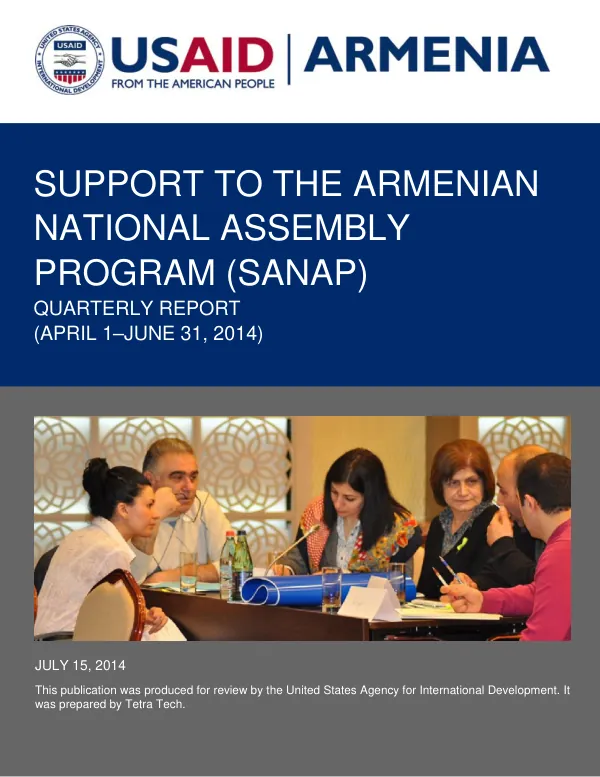
Support to the Armenian National Assembly Program (SANAP) Quarterly Report (April 1–June 30, 2014)
Sign inTETRA TECH
Support to the Armenian National Assembly Program (SANAP) Quarterly Report (April 1–June 30, 2014)
The Support to the Armenian National Assembly Program (SANAP) was established in 2012 with a four-year implementation period.
2014 · 97 pages
Sign in to readA free account is required to download.
Abstract
The program aims to strengthen the National Assembly's institutional capacity by achieving four objectives: increasing representation of citizens' interests, improving oversight of the executive branch, enhancing analytical capacity of selected committees, and making rules and procedures governing selected committees clearer and more institutional. During the first year of the project, SANAP worked with five standing committees, including the Financial- Budgetary Affairs, Protection of Human Rights and Public Affairs, State and Legal Affairs, Territorial Affairs and Self-Government, and Ethics committees. Beginning in October 2014, SANAP expanded its work to three additional committees: Healthcare, Maternity and Childhood, Agriculture and Environment, and Economic Affairs. SANAP focuses on building the capacity of selected committees by strengthening the skills and knowledge of committee Members of Parliament (MPs), enhancing rules and procedures of select committees, improving legislative analysis by staff and members, and expanding outreach to citizens and civil society. The program also works with individual MPs elected from single-member districts who want to strengthen constituent engagement and with women MPs interested in forming a non-partisan group for collective policy advocacy. The program supports USAID projects that require parliament consideration and has limited involvement with the quasi-judicial Ethics Committee, focusing on strengthening its rules and procedures and increasing awareness of its role among all MPs. During the quarter covered by this report, significant leadership changes occurred in top government positions, affecting the political landscape and directly impacting SANAP's work. The Armenian Constitutional Court ruled that the country's pension legislation was unconstitutional, and the Prime Minister announced his resignation. SANAP worked with the five standing committees to strengthen the skills and knowledge of committee Members of Parliament (MPs), enhance rules and procedures of select committees, and improve legislative analysis by staff and members. The program also expanded outreach to citizens and civil society, supporting USAID projects that require parliament consideration. The program's activities were divided into four objectives: increasing representation of citizens' interests, improving oversight of the executive branch, enhancing analytical capacity of selected committees, and making rules and procedures governing selected committees clearer and more institutional. Objective One: Representation of Citizens' Interests Increased * Activities Performed: SANAP worked with the five standing committees to strengthen the skills and knowledge of committee Members of Parliament (MPs), enhance rules and procedures of select committees, and improve legislative analysis by staff and members. * Activities Planned: SANAP planned to continue working with the five standing committees, expanding outreach to citizens and civil society, and supporting USAID projects that require parliament consideration. * Past and Ongoing Challenges/Solutions: SANAP faced challenges in engaging with the quasi-judicial Ethics Committee due to its limited involvement in the project. Objective Two: Executive Branch Oversight Improved Objective Three: Analytical Capacity of Selected Committees Increased Objective Four: Rules and Procedures Governing Selected Committees Made Clearer and More Institutional SANAP also supported the establishment of a Women MP Group, which aimed to promote collective policy advocacy among women MPs. The program's activities were guided by a Performance Monitoring Plan (PMP) and were subject to regular monitoring and evaluation.