USAID DEC
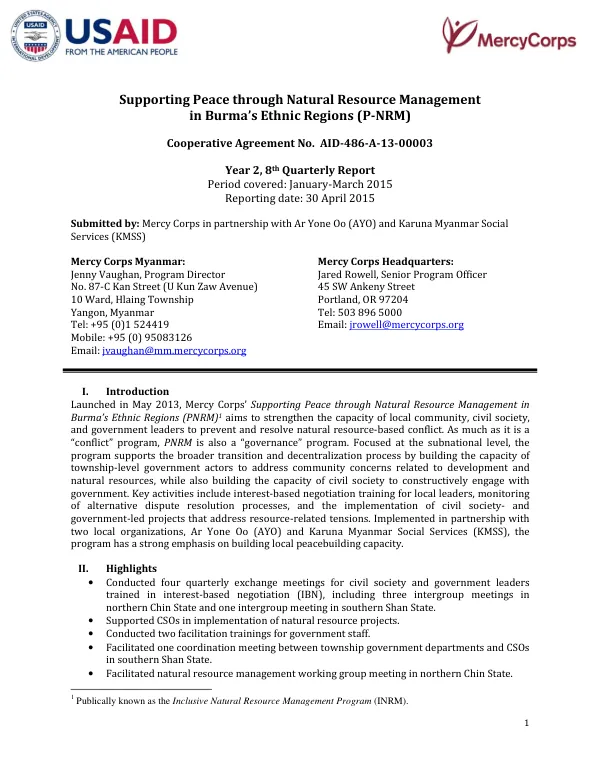
Supporting Peace through Natural Resource Management in Burma’s Ethnic Regions (P-NRM)
Sign inMERCY CORPS INTERNATIONAL
Supporting Peace through Natural Resource Management in Burma’s Ethnic Regions (P-NRM)
The Supporting Peace through Natural Resource Management in Burma's Ethnic Regions (P-NRM) program aims to strengthen the capacity of local community, civil society, and government leaders to prevent and resolve natural resource-based conflict.
2015 · 9 pages
Sign in to readA free account is required to download.
Abstract
Launched in May 2013, the program is implemented in partnership with two local organizations, Ar Yone Oo (AYO) and Karuna Myanmar Social Services (KMSS), and focuses on building local peacebuilding capacity. Key activities under the program include interest-based negotiation training for local leaders, monitoring of alternative dispute resolution processes, and the implementation of civil society- and government-led projects that address resource-related tensions. The program has a strong emphasis on building local peacebuilding capacity and supporting the broader transition and decentralization process by building the capacity of township-level government actors to address community concerns related to development and natural resources. During the reporting period, the program team conducted four quarterly exchange meetings for civil society and government leaders trained in interest-based negotiation, including three intergroup meetings in northern Chin State and one intergroup meeting in southern Shan State. These meetings provided a platform for participants to share their conflict resolution experiences, reflect on their experiences, and learn from each other. Participants found the quarterly exchange meetings very useful for their capacity building and networking. The program also supported CSOs in the implementation of natural resource projects, conducted two facilitation trainings for government staff, and facilitated one coordination meeting between township government departments and CSOs in southern Shan State. Additionally, the program team conducted 55 meetings with government representatives at the state and township levels and produced the fourth edition of the quarterly newsletter, which included discussion points from the quarterly exchange meetings, a dispute resolution case study, and INRM program information. The program recorded 68 dispute resolution attempts over the life of the program by participating leaders in the dispute resolution monitoring system. To date, participating leaders resolved 54 of the 68 disputes, with most of these disputes concerning natural resources. The program also strengthened the capacity of local organizations to implement projects that address natural resource tensions through partner sub-grants, partner capacity building, and learning workshops. The partner sub-grants ended on March 31, 2015, and partner project teams were trained in facilitation skills as part of facilitation training for government staff. A learning workshop was also organized with partners KMSS and AYO on 25-26 March 2015 to review the achievements and challenges for each objective and ensure that learning points were captured to inform future programming. Each partner completed a self-assessment of their conflict management technical capacity, providing endline data against the baseline conflict management technical capacity assessments each partner conducted in July 2013. The results of the self-assessment showed significant improvements in the conflict management technical capacity of both KMSS and AYO. KMSS showed an 18% increase in their conflict management technical capacity, while AYO showed a 40% increase. The program's efforts to strengthen the capacity of local organizations to implement projects that address natural resource tensions have been successful, and the program is expected to continue its support to these organizations in the future. The program's geographic focus is on Burma's ethnic regions, with a specific emphasis on Chin and Shan States. The program's timeframes are from May 2013 to the present, with the current report covering the period from January to March 2015. The program's recommendations include expanding the program to other townships in Shan State and continuing to support the capacity building of local organizations to implement projects that address natural resource tensions.