USAID
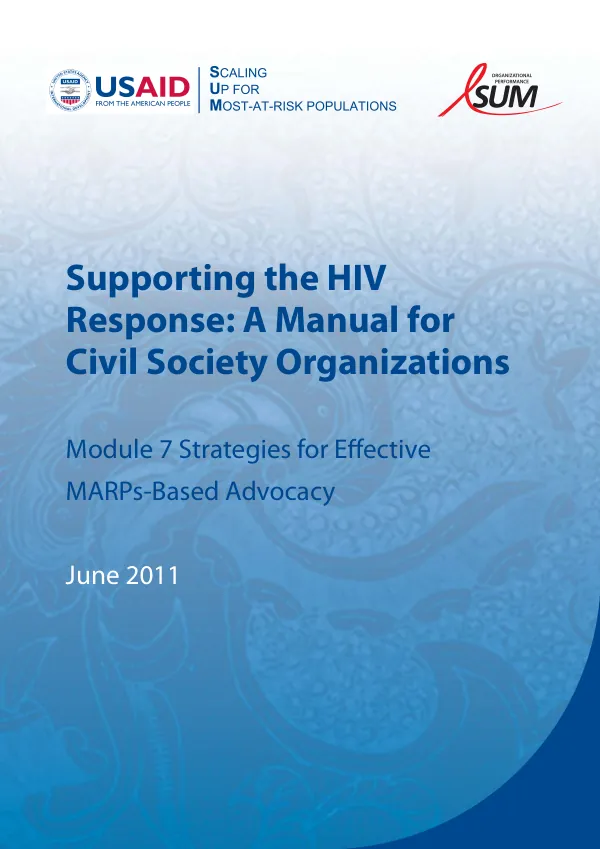
Supporting the HIV Response: A Manual for Civil Society Organizations
The HIV Response: A Manual for Civil Society Organizations, Module 7 Strategies for Effective MARPs-Based Advocacy, was published in June 2011.
2011 · 30 pages
Sign in to readA free account is required to download.
Abstract
The manual focuses on strategies for effective advocacy for Most At Risk Populations (MARPs) in the context of HIV response. The manual emphasizes the importance of understanding the needs and challenges of MARPs, including sex workers, men who have sex with men, injecting drug users, and others. It highlights the need for civil society organizations to engage in advocacy efforts to address the social and economic determinants of HIV vulnerability among these populations. The manual provides guidance on developing effective advocacy strategies, including building alliances with key stakeholders, conducting research and analysis, and using various communication channels to raise awareness and influence policy. It also emphasizes the importance of working with MARPs themselves to ensure that their voices and perspectives are represented in advocacy efforts. The manual highlights the need for a comprehensive approach to addressing the HIV epidemic among MARPs, including providing access to HIV prevention, treatment, and care services, as well as addressing the social and economic determinants of HIV vulnerability. It also emphasizes the importance of addressing the human rights and dignity of MARPs, including their right to access health services, education, and employment. The manual provides case studies and examples of successful advocacy efforts by civil society organizations in various countries, highlighting the importance of context-specific approaches to advocacy. It also emphasizes the need for ongoing monitoring and evaluation of advocacy efforts to ensure their effectiveness and impact. The manual is intended for civil society organizations, policymakers, and other stakeholders working on HIV response and advocacy for MARPs. It provides a comprehensive guide to effective advocacy strategies and approaches, highlighting the importance of working with MARPs themselves to address the HIV epidemic. The manual's recommendations for effective advocacy include: * Building alliances with key stakeholders, including government, international organizations, and other civil society organizations * Conducting research and analysis to inform advocacy efforts * Using various communication channels, including media, social media, and community outreach, to raise awareness and influence policy * Working with MARPs themselves to ensure that their voices and perspectives are represented in advocacy efforts * Addressing the social and economic determinants of HIV vulnerability, including poverty, lack of education, and social exclusion * Providing access to HIV prevention, treatment, and care services * Addressing the human rights and dignity of MARPs, including their right to access health services, education, and employment. Overall, the manual provides a comprehensive guide to effective advocacy strategies and approaches for addressing the HIV epidemic among MARPs, highlighting the importance of working with MARPs themselves and addressing the social and economic determinants of HIV vulnerability.
Related documents