THE INTERNATIONAL REPUBLICAN INSTITUTE
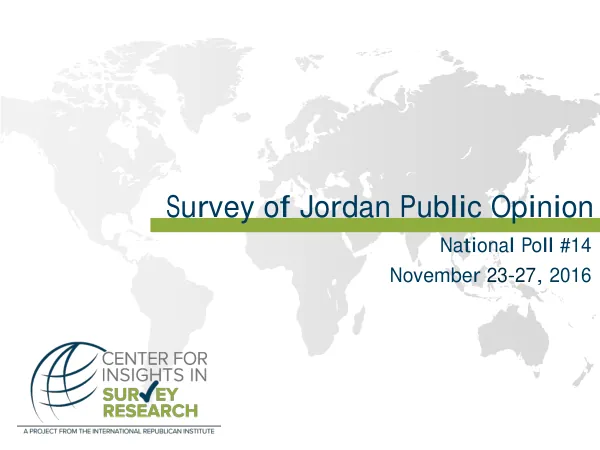
Survey of Jordan Public Opinion
Jordan Public Opinion Survey Results The survey, conducted from November 23 to 27, 2016, involved 1,000 adults aged 18 and older in face-to-face interviews in their homes.
2016 · 61 pages
Sign in to readA free account is required to download.
Abstract
The sample design consisted of a multi-stage cluster sample, with a total of 100 clusters distributed among Jordan's 12 governorates. The Nyman allocation approach was used to ensure proper coverage for governorates with small population sizes. The survey found that 25% of respondents believed Jordan was headed in the right direction, while 39% believed it was headed in the wrong direction. The main reasons cited for considering things in Jordan to be going in the right direction included improved citizens' daily conditions, political reforms, and the Hashemite leadership. In contrast, the main reasons cited for considering things in Jordan to be going in the wrong direction included widespread drug use, wrong government policies, and the refugee influx. When asked about the single biggest problem facing Jordan as a whole, respondents cited rising cost of living, unemployment, poverty, terrorism, and Jordan's economic conditions. The current economic situation in Jordan was described as very good or good by 54% of respondents, who cited factors such as the provision of basic services, natural resources, and stability of economic conditions. The survey also found that 40% of respondents believed the economy was going in the wrong direction, citing factors such as unemployment, poverty, and administrative and financial corruption. The refugee influx and widespread drug use were also cited as major problems facing Jordan. In terms of the economic situation, 22% of respondents described it as bad, while 13% described it as very bad. The main reasons cited for considering the economy to be very good or good included the provision of basic services, natural resources, and stability of economic conditions. Overall, the survey results suggest that Jordanians have mixed views about the direction of their country, with some citing improvements in citizens' daily conditions and others citing major problems such as unemployment and poverty. The economic situation in Jordan is also a major concern, with many respondents citing factors such as rising cost of living and unemployment as major problems.
Related documents