ACTED
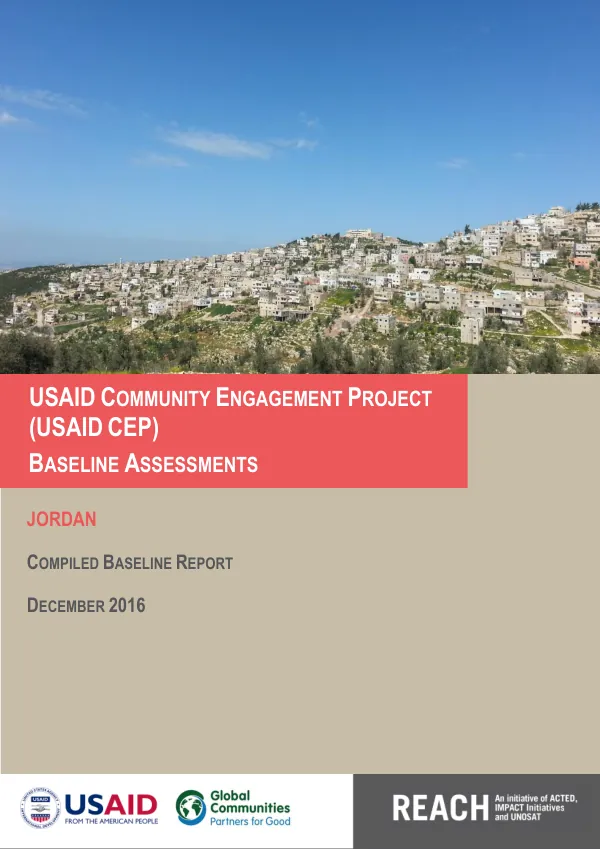
USAID Community Engagement Project (USAID CEP) Baseline Assessments in Jordan
The USAID Community Engagement Project (USAID CEP) in Jordan aims to increase community resilience and support social cohesion within 19 communities in Mafraq, Irbid, and Tafileh governorates.
2016 · 102 pages
Sign in to readA free account is required to download.
Abstract
The project began in 2014 and is a five-year activity that seeks to achieve this goal by building community cohesion and enhancing the resilience of communities to address evolving challenges. Implementation of USAID CEP involves working through and building the capacity of Community Enhancement Teams (CETs), municipalities/local government, and Community-Based Organizations (CBOs) to support communities in identifying and prioritizing stressors, developing short- and long-term solutions to challenges, and using effective and transparent communication to strengthen community cohesion. Two baseline assessments were conducted to measure levels of resilience and social cohesion in the communities targeted by CEP. The first baseline assessment was conducted by the Middle East Marketing and Research Consultants (MEMRC) between March and August 2014 in the initial nine communities targeted by USAID CEP in 2014. This baseline sought to establish perceptions of social cohesion and resilience in various communities in Mafraq, Irbid, and Tafileh governorates. The baseline assessments looked into both the horizontal dimension of social cohesion, i.e., intra-community cohesion, and the vertical social cohesion dimension, i.e., cohesion between citizens and different levels of government. A range of factors were assessed to provide an overview of social cohesion for these two dimensions. Key findings from the baseline assessments indicate that the horizontal dimension of social cohesion was robust, with strong intra-community cohesion in the majority of assessed communities. Community members reported strong personal relationships, and the existence of reliable networks of support and assistance, primarily within families, but also among neighbours and between Jordanians and Syrians. Levels of mutual respect and trust within the community were also reported to be high. However, the vertical dimension of social cohesion was found to be weaker, with community members expressing dissatisfaction with municipal and government service provision, and limited participation in administrative decision-making. Overall, the baseline assessments provide a comprehensive understanding of the social cohesion and resilience landscape in the communities targeted by USAID CEP. The findings will serve as a baseline for the project's implementation and will inform evidence-based programming and project implementation.