FEDERAL MINISTRY OF HEALTH OF NIGERIA
Sustainability Road Map for HIV Response (2016 - 2018)
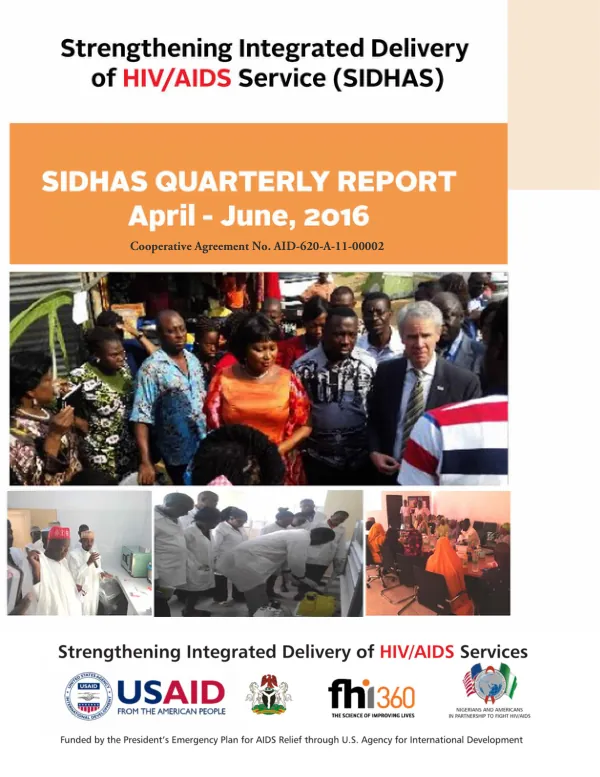
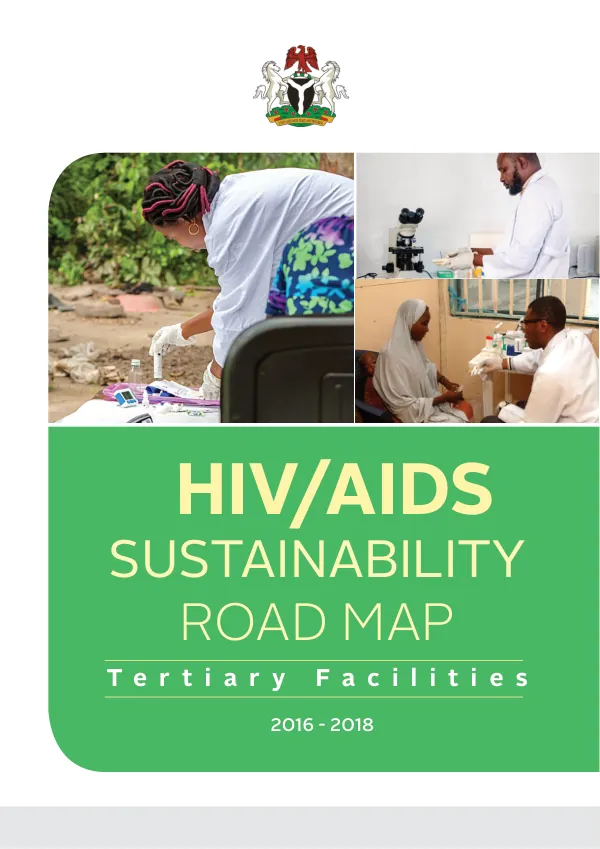
The HIV/AIDS sustainability road map for tertiary facilities in Nigeria was developed to provide a systematic framework for transitioning leadership and funding of HIV response to achieving domestic sustainability in the long term.
2016 · 183 pages
Sign in to readA free account is required to download.
Abstract
The road map was made possible through the support of the United States Agency for International Development (USAID) and the SIDHAS project. Key stakeholders, including the Federal Ministry of Health, State governments, and implementing partners, contributed to the development of the document. The road map aims to address the issue of external funding for disease-specific programs, which is often time-bound and can lead to the discontinuation of program implementation at the end of the funding cycle. Sustainability becomes an important consideration right from program design to ensure that implementation continues after close-out of external funding. The road map is expected to assist states in taking ownership and charting the course towards domestic resourcing of the HIV response. The document highlights the importance of transitioning HIV services from one funding source to another, which requires rigorous planning, commitment, and pursuit of sustainability goals. It also emphasizes the need for increased domestic funding of HIV services at national and sub-national levels. The road map provides a framework for achieving domestic sustainability in the long term and is expected to contribute to the goal of ending AIDS in Nigeria. The road map was developed in collaboration with key stakeholders, including the Federal Ministry of Health, State governments, and implementing partners. It is expected to be used in conjunction with other relevant resource documents to improve domestic funding for the HIV/AIDS response. The document is endorsed by key stakeholders, including the Director of Public Health at the Federal Ministry of Health, the Director of the Department of Health Planning, Research & Statistics, and the Director General of the National Agency for the Control of AIDS. The road map is one of the five pillars of the current PEPFAR 3.0 phase, which focuses on controlling the HIV/AIDS epidemic and delivering on the promise of an HIV/AIDS-free generation. The Sustainability Action Agenda recognizes that PEPFAR alone does not have the resources to achieve these objectives and promotes domestic resource mobilization to support the HIV/AIDS response. The road map provides a framework for achieving domestic sustainability in the long term and is expected to contribute to the goal of ending AIDS in Nigeria. It is a critical step towards transitioning HIV services from one funding source to another and ensuring that implementation continues after close-out of external funding. The road map is expected to be used by all stakeholders, including state governments, implementing partners, and the Federal Ministry of Health, to improve domestic funding for the HIV/AIDS response. The road map was developed for 12 tertiary facilities in Nigeria, including Abubakar Tafawa Balewa University Teaching Hospital, Bauchi; Federal Medical Centre, Azare; Federal Medical Centre, Birnin Kudu; Federal Medical Centre, Nguru; Federal Medical Centre, Yenagoa; Irrua Specialist Hospital, Irrua; Nnamdi Azikiwe University Teaching Hospital, Awka; University of Benin Teaching Hospital, Benin; University of Calabar Teaching Hospital, Calabar; University of Maiduguri Teaching Hospital, Maiduguri; University of Port Harcourt Teaching Hospital, Port Harcourt; and University of Uyo Teaching Hospital, Uyo.
Related documents
Documents in this collection
 2021
2021USAID DEC
Optimizing Antiretroviral Treatment and Viral Suppression for Adolescents and Young People Living with HIV by Implementing Operation Triple Zero in Four States in Nigeria: Lessons Learned
Open record 2021
2021USAID DEC