GOVERNMENT OF UGANDA
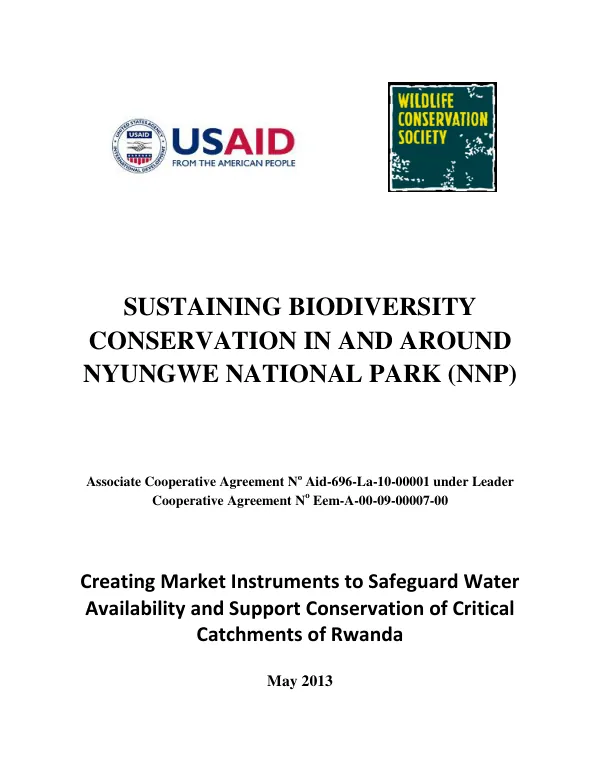
Sustaining Biodiversity Conservation in and Around Nyungwe National Park (NNP)
However, the focus of this document is on sustaining biodiversity conservation in and around Nyungwe National Park (NNP).
2013 · 23 pages
Sign in to readA free account is required to download.
Abstract
The document highlights the importance of water conservation in Rwanda, a country heavily reliant on surface waters for agriculture, domestic uses, and energy production. Rwanda's Vision 2020 document emphasizes the need to maintain its water resources in lakes, rivers, critical catchments, and wetlands for social and economic development. The water sub-sector in Rwanda faces several challenges, including land degradation and water pollution, growing water demand amidst high population growth and climate change, and inadequate and reliable financing. Restoring degraded lands and avoiding degradation of remaining intact landscapes is crucial for improving water quality and quantity, supporting economic development in the country. A key area for action is in Nyungwe National Park (NNP), which plays a vital role in intercepting precipitation, filtering runoff, and mediating water quality into Africa's two largest hydrological networks. Creating Market Instruments to Safeguard Water Availability and Support Conservation of Critical Catchments of Rwanda is a project aimed at establishing Payments for Watershed Services (PWS) scheme in Nyungwe National Park, SW Rwanda. The project seeks to shift the perception of water as a free good to water as a service provided by healthy ecosystems and create market instruments that ensure the availability of water now and for future generations. The project focuses on creating a market-based approach to water conservation, where landowners and communities are incentivized to conserve and restore watersheds. The project's background and context highlight the importance of water conservation in Rwanda, citing the country's high population growth, competing demand for water by various economic sectors, and the need to address the looming water crisis. The project also emphasizes the need for integrated watershed management, recognizing that investments in water development projects alone are not sufficient to address the water crisis. The project's role in Rwanda's economic development goals is to support the country's Vision 2020 document, which aims to build a diversified, integrated, competitive, and dynamic economy. The project's approach involves creating a market-based instrument to incentivize landowners and communities to conserve and restore watersheds. The instrument will provide financial benefits to landowners and communities that conserve and restore watersheds, thereby creating a market-based approach to water conservation. The project's expected outcomes include improved water quality and quantity, increased agricultural productivity, and enhanced biodiversity conservation in and around Nyungwe National Park. The project's implementation will involve several key activities, including the establishment of a PWS scheme, the development of a market-based instrument, and the provision of financial benefits to landowners and communities that conserve and restore watersheds. The project's expected timeline is not specified, but it is anticipated that the project will have a significant impact on water conservation in Rwanda and support the country's economic development goals.
Related documents