RTI INTERNATIONAL
USAID Tuhifadhi Maliasili Activity Monthly Report- October 2023
The USAID Tuhifadhi Maliasili Activity is a program aimed at promoting biodiversity conservation and natural resource management in Tanzania.
2023 · 8 pages
Sign in to readA free account is required to download.
Abstract
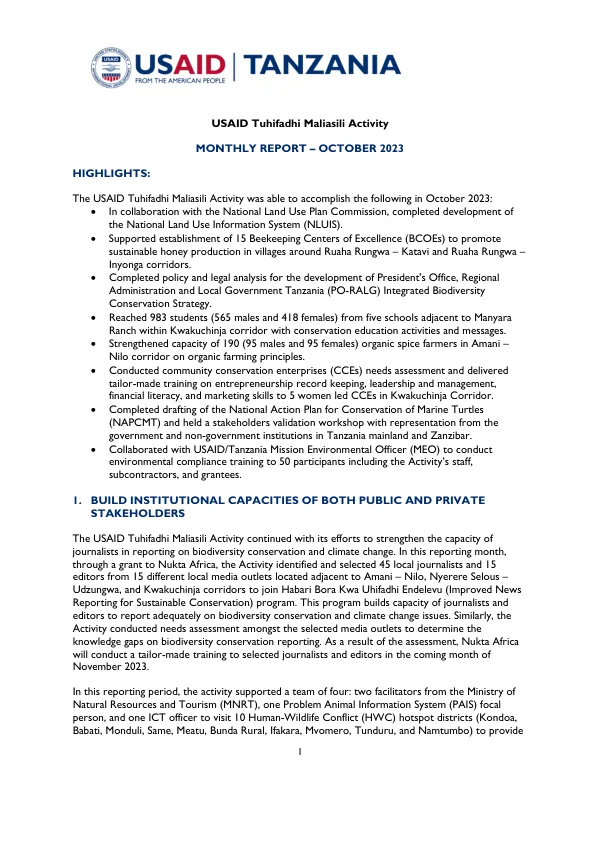
In October 2023, the Activity achieved several milestones in its efforts to strengthen institutional capacities, increase private sector engagement, and improve the policy and regulatory environment for biodiversity conservation. In collaboration with the National Land Use Plan Commission, the Activity completed the development of the National Land Use Information System (NLUIS). This system is expected to provide a comprehensive database for land use planning and management in Tanzania. Additionally, the Activity supported the establishment of 15 Beekeeping Centers of Excellence (BCOEs) to promote sustainable honey production in villages around Ruaha Rungwa – Katavi and Ruaha Rungwa – Inyonga corridors. The Activity also strengthened the capacity of 190 organic spice farmers in Amani – Nilo corridor on organic farming principles. Through a grant to GFP Organic Limited, the farmers received training on how to establish spice and tree nurseries, identify tree species for agroforestry practices, and select sites for nursery establishment. Furthermore, the Activity trained spice farmers on how to establish and manage clove farms to increase production, quality, and income while conserving the environment. In the area of policy and regulatory environment, the Activity completed and submitted a policy and legal analysis report for the development of the President's Office, Regional Administration and Local Government Tanzania (PO-RALG) Integrated Biodiversity Conservation Strategy. The strategy aims to provide guidelines and necessary actions for the conservation of biodiversity, address climate change, and ensure sustainable environmental management at the Local Government Authority level in Tanzania. The Activity also re-submitted the draft four of the revised National Wildlife Policy Implementation Strategy for review. The consultant has addressed all additional comments and inputs by stakeholders within the Ministry of Natural Resources and Tourism (MNRT)/Wildlife Division (WD). The Activity is currently facilitating coordination with the WD for the next steps, including the stakeholders' validation workshop for the strategy and further approval processes within the MNRT. In addition, the Activity organized coordination meetings with Tanzania Wildlife Research Institute (TAWIRI), Jane Goodall Institute (JGI), Frankfurt Zoological Society (FZS), and USAID to discuss the progress on work and harmonize administrative and technical processes on chimpanzee surveys. As a result of these consultative meetings, FZS will modify the approach of their work in two phases, with preliminary data collection to generate data for informing the review of the National Chimpanzee Conservation Action Plan (NCCAP), followed by a more comprehensive and standardized assessment in coordination with JGI in July – September 2024. The Activity also supported the development of a corridor management plan (CMP) for the Nyerere Selous – Udzungwa Corridor through a grant to Mtandao wa Jamii wa Usimamizi wa Misitu Tanzania (MJUMITA). The CMP aims to provide guidelines and necessary actions for the management of wildlife corridors at the local level. The draft CMP is currently under review by an expert from the Tanzania Wildlife Management Authority (TAWA). Furthermore, the Activity supported the establishment of 983 students from five schools adjacent to Manyara Ranch within Kwakuchinja corridor with conservation education activities and messages. The Activity also strengthened the capacity of 190 organic spice farmers in Amani – Nilo corridor on organic farming principles, and conducted community conservation enterprises (CCEs) needs assessment and delivered tailor-made training on entrepreneurship record keeping, leadership and management, financial literacy, and marketing skills to 5 women-led CCEs in Kwakuchinja Corridor. The Activity also collaborated with USAID/Tanzania Mission Environmental Officer (MEO) to conduct environmental compliance training to 50 participants, including the Activity's staff, subcontractors, and grantees. The training aimed to ensure that all stakeholders are aware of the environmental regulations and guidelines for the Activity's projects. Overall, the USAID Tuhifadhi Maliasili Activity made significant progress in October 2023 in promoting biodiversity conservation and natural resource management in Tanzania. The Activity's efforts to strengthen institutional capacities, increase private sector engagement, and improve the policy and regulatory environment for biodiversity conservation are expected to have a positive impact on the conservation of biodiversity and natural resources in Tanzania.
Related documents