CARITAS INTERNATIONAL
USAID Ejo Heza Phase I Report
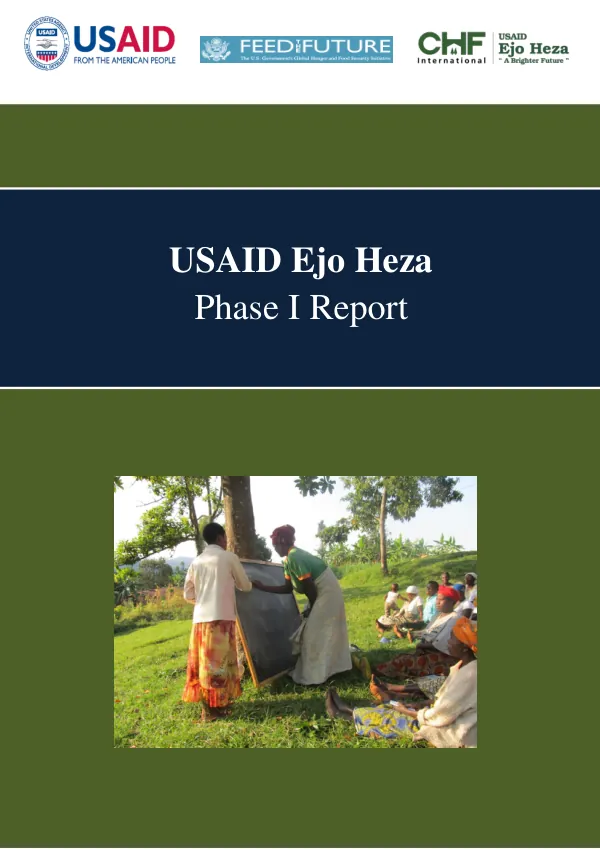
The USAID Rwanda Integrated Improved Livelihoods Program, locally known as Ejo Heza, has been implemented in eight Rwandan districts over the past 18 months.
2013 · 17 pages
Sign in to readA free account is required to download.
Abstract
The program has successfully reached over 15,000 rural Rwandan households with crucial assistance from the Government of Rwanda and four local Rwandan Partner Organizations. The program's goal is to improve the livelihoods and food consumption of rural poor, particularly women, by building the capacity of low-income households to access financial services and supporting the financial service provision-sector's ability to develop and deliver effective products for this clientele. The program is being implemented in an integrated manner, along four key elements: increased demand for financial services, increased supply of financial services, behavior change and marketing, and health and nutrition. The program has successfully formed 702 internal savings and loan groups, with 45% of these opening a bank account. A "Mapping the Financial Sector Landscape" study was conducted to assist in the quick scaling up of program activities. Behavior change and social marketing approaches have been used to sensitize the population on the benefits of financial services, improving production practices, working cooperatively, and improving access to health and nutrition services. Over 1,200 Behavior Change Volunteers were trained in critical areas of USAID Ejo Heza implementation. The program has also implemented complementary short-term and long-term actions to ensure that the most vulnerable populations attain skills and knowledge that lead to greater food security and greater understanding of diet, nutrition, and hygiene. A Household Economy Approach Assessment was conducted to better understand the starting point of rural Rwandan's livelihoods. The assessment examined both the availability of food as well as rural household's ability to access this food. Key findings of the assessment include: all wealth groups in all identified livelihood zones live below $1.25 per day, most households belonged to Ubedehe Category 1, 2, and 3; households in category 2 have strength in their human capital, but all households fell below annual energy requirements; many households in category 3 and 4 engage in internal savings and loan groups or cooperatives; and all households could benefit from off and on-farm interventions. The assessment not only shaped the monitoring framework but also pointed to the need to start with basics to bring skill levels up, from basic literacy to basic nutrition training with targeted households. A Knowledge, Attitudes, and Practices survey was also conducted to look at the knowledge, attitudes, and practices of target households in four of the eight USAID Ejo Heza districts in regards to agriculture, nutrition, and literacy. The survey found that households in category 2 have strength in their human capital, but all households fell below annual energy requirements. The program has made significant progress in its first phase, with over 27,900 Rwandans accessing agricultural extension services and 4,856 kitchen gardens completed. The program has also trained over 1,200 Behavior Change Volunteers and formed 702 internal savings and loan groups. The program's success has been attributed to its integrated approach, which addresses the needs of rural poor households and supports the financial service provision-sector's ability to develop and deliver effective products for this clientele.