FINTRAC
Sweet Potato Post Harvest Manual USAID-KHCP
The Kenya Horticulture Competitiveness Project (USAID-KHCP) aims to achieve a highly competitive horticulture industry and improve food security through increasing on-farm productivity, enhancing value-added processing, improving coordination among horticulture value-chain participants, and increasing the capacity of local organizations to provide improved technical services to smallholders.
2012 · 8 pages
Sign in to readA free account is required to download.
Abstract
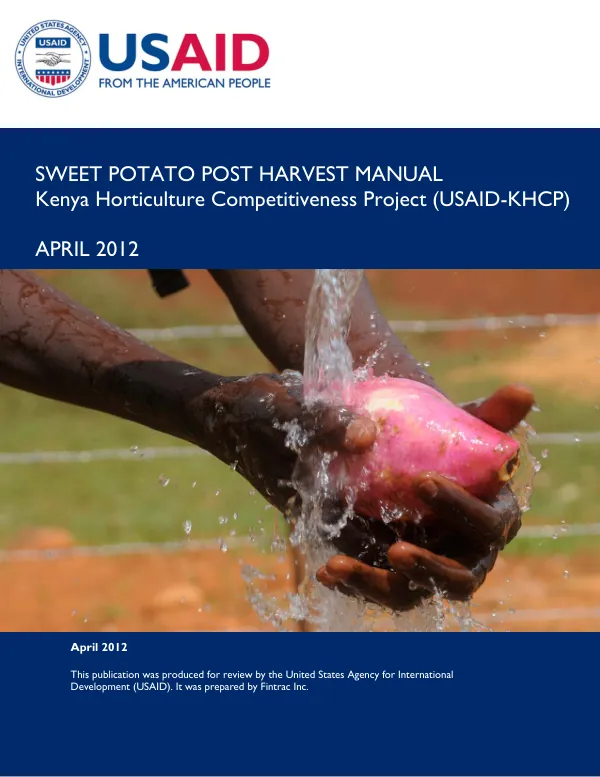
The Orange Fleshed Sweet Potato (OFSP) is a focus value chain in USAID-KHCP due to its potential to contribute to Kenyan household nutrition and income. However, current smallholder yields are between one-third and one-fourth of their potential, and there is a lack of knowledge and experience in reducing postharvest losses and achieving/maintaining export quality. To address this, USAID-KHCP is promoting new cultivars and building the capacity of partners, farmer groups, and their members with a focus on good agricultural practices. The program invited Dr. Chris Bishop, an expert in post-harvest handling, to provide advanced training in post-harvest best practice for sweet potato. This training aimed to build technical capacity of farmers and extension agents, establish an awareness of what is required in export and how to achieve it, develop skills and expertise necessary to meet export standards for quality, and enhance technical linkages to harmonize research and best practice recommendations. The post-harvest handling of sweet potatoes is critical to ensure a well-grown crop does not become a waste. After harvest, the sweet potato is still a live product and can lose moisture, become diseased, or bruised depending on what happens. To prevent this, it is essential to avoid cuts in harvest, beware of grazes and scratches in handling and washing, and cut out dehydration by placing the tubers in cool storage. Curing in the field for at least 24 hours after harvest is also necessary to prevent disease and moisture loss. Sizing and grading of sweet potatoes is another critical step in the post-harvest process. This should be done in the field before the tubers are brought back to the pack house, using plastic crates that can be washed. The bottom of the crate should have either a small amount of potato haulm or a plastic weaved sacking material to prevent damage to the tubers. Once the tubers are brought into the packhouse, they are ready for washing, which involves immersing the crates in a tank of water for at least 4-5 minutes to soften the soil on the surface, followed by washing using water under pressure. Crate-dipping in a chlorine tank at a concentration of 200ppm for 10 seconds is also necessary to prevent disease. The final curing process involves placing the tubers on racks or in half-filled clean plastic crates to dry and cure for 1-2 days. Finally, the sweet potatoes are packed and despatched. The actual duration for the operation from harvest to packing can vary, but it is essential to follow these steps to ensure a high-quality product that meets export standards.