USAID DEC
System Training Plan for End Users: USAID/Ghana Justice Sector Reform Case Tracking System Activity
Sign inCHEMONICS
System Training Plan for End Users: USAID/Ghana Justice Sector Reform Case Tracking System Activity
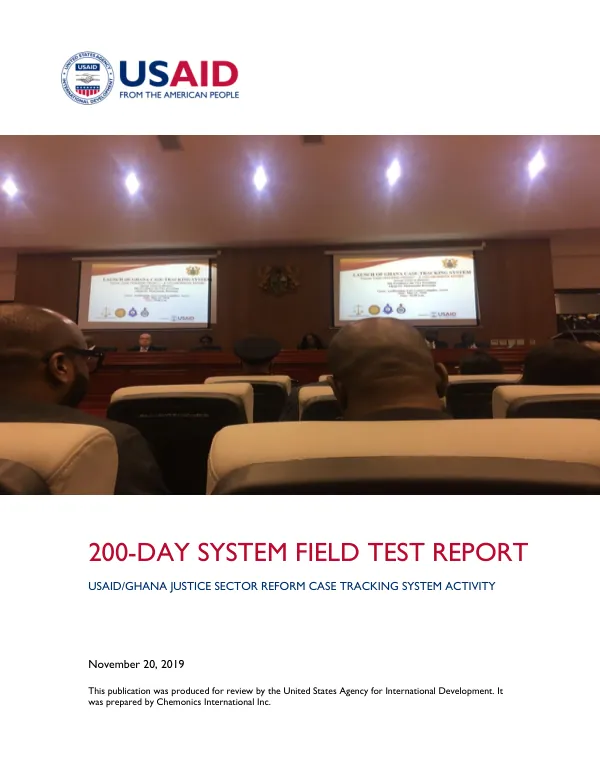
The USAID/Ghana Justice Sector Reform Case Tracking System (CTS) Activity aims to develop an integrated CTS to support the Government of Ghana's ability to effectively investigate and prosecute criminal acts.
2019 · 14 pages
Sign in to readA free account is required to download.
Abstract
The project has three objectives: develop a comprehensive design and sustainable roll-out process for an integrated CTS, implement a testing phase and identify the requirements for the sustainable use and expansion of the integrated CTS, and improve procedures and policies to strengthen change management, coordination, and communication across key justice-sector institutions that sustain the use of an integrated CTS. The CTS Activity is implemented by Chemonics International, in conjunction with subcontractors Inter-regional Bridge Group and Transnational Development Associates. The project focuses on improving Ghana's ability to track criminal cases from their introduction into the system to their prosecution, trial, and sentencing in the courts, and execution of the sentence in prison. The CTS Activity will improve information sharing and coordination among Ghana's law enforcement and judicial authorities and increase the efficiency and effectiveness in investigating and prosecuting criminal cases of all types, especially those related to corruption, border security, maritime security, and cybercrime. The CTS Activity has identified three key areas of focus: developing a comprehensive design and sustainable roll-out process for an integrated CTS, implementing a testing phase and identifying the requirements for the sustainable use and expansion of the integrated CTS, and improving procedures and policies to strengthen change management, coordination, and communication across key justice-sector institutions that sustain the use of an integrated CTS. The project will be implemented in three phases, with the first phase focusing on developing the CTS design and roll-out process, the second phase focusing on testing and identifying the requirements for sustainable use and expansion, and the third phase focusing on improving procedures and policies to strengthen change management, coordination, and communication. The CTS Activity has conducted a skills and capacity assessment of KSA staff, which has identified a substantial number of staff lacking basic computer skills necessary to utilize the CTS. To address this, the project will conduct a staggered approach to the testing phase, ensuring that basic computer skills trainings can be conducted prior to training on formal data entry into the CTS. The training plan will include basic computer skills trainings, CTS system application usage training, CTS change management training, CTS system equipment usage and maintenance training, CTS data usage and maintenance training, CTS pilot site management and reporting training, CTS data entry training, and CTS email usage training. The training plan will be overseen by Systems Developer, Chris Munga, and will be delivered by Mr. Munga, his IBG colleagues, and the nine ICT Focal Points. The training will be conducted in a phased approach, with each individual or group KSA training sessions including an introduction to the CTS application, in-person demonstration of overall tabs/screens of the CTS, a questions and answer session, and a one-on-one training session for individual functional users. The training will be tailored to meet the specific needs of each KSA and KSA functional group, and will include real case files with actual data to ensure that users are familiar with the system's functionality.