CHEMONICS
Agriculture Policy Support Project Quarterly Report (April - July 2018)
The Agriculture Policy Support Project (APSP) in Ghana focused on strengthening policy-making and increasing private sector participation in the agricultural sector.
2018 · 38 pages
Sign in to readA free account is required to download.
Abstract
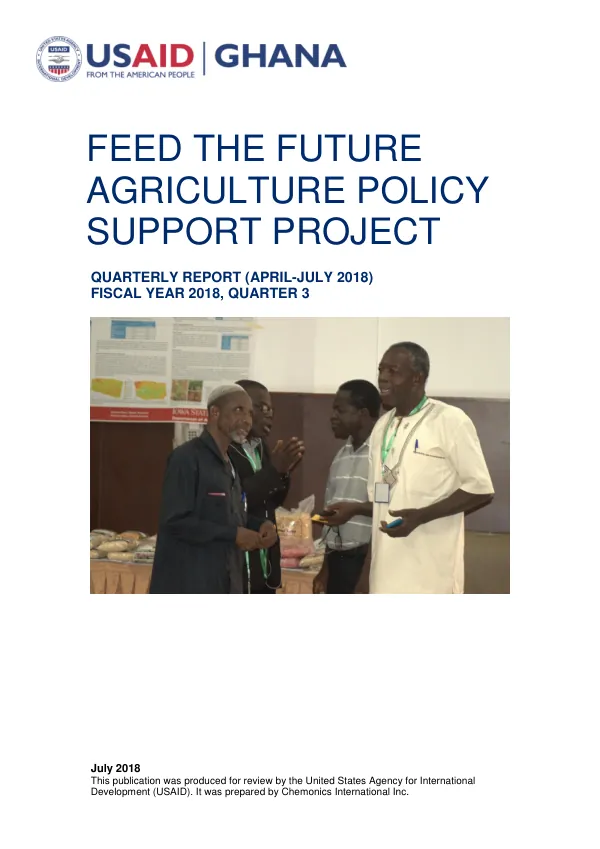
During the third quarter of Fiscal Year 2018, the project consolidated its activities on its exit strategy and contractual mandate. Key initiatives included finalizing interventions to strengthen the Ministry of Food and Agriculture's (MoFA) institutional capacity for rigorous policy planning and analysis, completing the development of the research agenda, and continuing research knowledge dissemination. The project also prioritized public-private dialogues and furthered the relationship between researchers and policy-makers. Additionally, APSP consolidated the impacts of other project interventions and finalized data collection to assess performance against contract indicators. A notable achievement during this quarter was the public hearing on Ghana's Land Bill, which was drafted with APSP technical assistance. The Parliamentary Select Committee on Land and Forestry organized the hearing, and APSP provided support. The hearing received feedback from public and private sector stakeholders, including the Minister of Lands and Natural Resources and other high-ranking officials. The combined input from the public sector and civil society was welcomed by the members of the Select Committee, making the hearing a success. The Land Bill aims to introduce transparency and accountability, reduce costs in land transactions, and improve access to land for agriculture. Its passage will create an enabling environment to attract increased private investments in agriculture. APSP's grantee, NETRIGHT, made a memorable presentation of a Memorandum on Ghana's Land Bill at the public hearing, highlighting the importance of promoting gender equality and social inclusion. The project also supported the development of the research agenda, which is essential for evidence-based policy-making. APSP continued to disseminate research knowledge and fostered the relationship between researchers and policy-makers. This collaboration is crucial for translating research findings into policy decisions that benefit the agricultural sector. In terms of private sector participation, APSP furthered public-private dialogues to advocate for an improved food security enabling environment. The project's efforts aimed to increase private sector engagement in the policy arena, which is essential for promoting sustainable agricultural development. Overall, the APSP's activities during the third quarter of Fiscal Year 2018 focused on consolidating its exit strategy, strengthening policy-making, and increasing private sector participation in the agricultural sector. The project's achievements, including the public hearing on the Land Bill and the development of the research agenda, demonstrate its commitment to promoting sustainable agricultural development in Ghana.