USAID DEC
Systematic monitoring of the voluntary medical male circumcision scale-up in Eastern and Southern Africa (SYMMACS): Interim report on results from Kenya, South Africa, Tanzania and Zimbabwe
Sign inTHE INFO PROJECT AT THE JOHNS HOPKINS BLOOMBERG SCHOOL OF PUBLIC HEALTH, CENTER FOR COMMUNICATION PROGRAMS
Systematic monitoring of the voluntary medical male circumcision scale-up in Eastern and Southern Africa (SYMMACS): Interim report on results from Kenya, South Africa, Tanzania and Zimbabwe
The adoption of the six elements of efficiency of VMMC service delivery in four countries - Kenya, South Africa, Tanzania, and Zimbabwe - was assessed through the SYMMACS study.
2012 · 2 pages
Sign in to readA free account is required to download.
Abstract
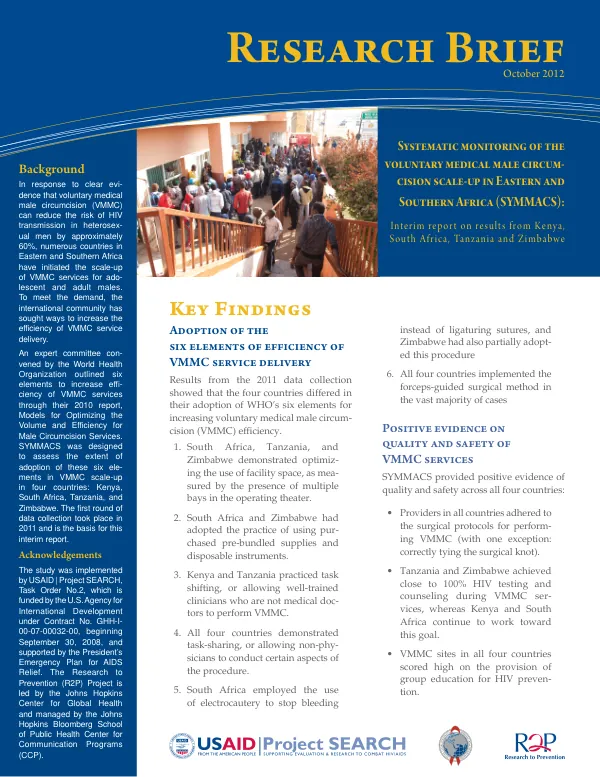
Results from the 2011 data collection showed that the four countries differed in their adoption of these elements. South Africa, Tanzania, and Zimbabwe demonstrated optimizing the use of facility space, as measured by the presence of multiple bays in the operating theater. South Africa and Zimbabwe had adopted the practice of using purchased pre-bundled supplies and disposable instruments. Kenya and Tanzania practiced task shifting, or allowing well-trained clinicians who are not medical doctors to perform VMMC. All four countries demonstrated task-sharing, or allowing non-physicians to conduct certain aspects of the procedure. South Africa employed the use of electrocautery to stop bleeding instead of ligaturing sutures, and Zimbabwe had also partially adopted this procedure. All four countries implemented the forceps-guided surgical method in the vast majority of cases. Positive evidence on quality and safety of VMMC services was provided by SYMMACS across all four countries. Providers in all countries adhered to the surgical protocols for performing VMMC, with one exception: correctly tying the surgical knot. Tanzania and Zimbabwe achieved close to 100% HIV testing and counseling during VMMC services, whereas Kenya and South Africa continue to work toward this goal. VMMC sites in all four countries scored high on the provision of group education for HIV prevention. The SYMMACS study was implemented by USAID | Project SEARCH, Task Order No.2, which is funded by the U.S. Agency for International Development under Contract No. GHH-I-00-07-00032-00, beginning September 30, 2008, and supported by the President's Emergency Plan for AIDS Relief. The Research to Prevention (R2P) Project is led by the Johns Hopkins Center for Global Health and managed by the Johns Hopkins Bloomberg School of Public Health Center for Communication Programs (CCP). Areas for improvement of VMMC services were identified in two or more countries, including inadequate systems for monitoring and reporting adverse events, lack of post-exposure prophylaxis (PEP) and guidelines for administering it onsite, occasional lapses in maintaining a sterile operating field, and providers not following WHO guidance on post-operative review of vital signs and use of protective eye gear. WHO service delivery guidelines were not readily available at many VMMC sites. Recommendations were made to achieve the six efficiency elements for VMMC services, including task-shifting, task-sharing, electrocautery, and pre-bundling of kits. Effective monitoring and reporting of adverse events, supervision, training, and protocols and guidelines were also recommended. Provider burnout was identified as an area for improvement, and diversifying the work of primary providers was suggested to avoid burnout from an exclusive focus on performing VMMC. The next steps for SYMMACS include finalizing the data collection for 2012 in a minimum of 30 sites per country during high-volume periods and disseminating the complete set of findings. Data collection from 2012 will allow for further assessment of capacity in these four countries to deliver VMMC services and continued progress toward the adoption of the six elements of efficiency. The final SYMMACS report will provide further insights into the dynamics of VMMC service delivery and inform the continuous improvement of VMMC service delivery in these four countries and throughout the region of Eastern and Southern Africa.
Related documents