FHI360
Understanding the dynamics of concurrent sexual partnerships in Malawi and Tanzania
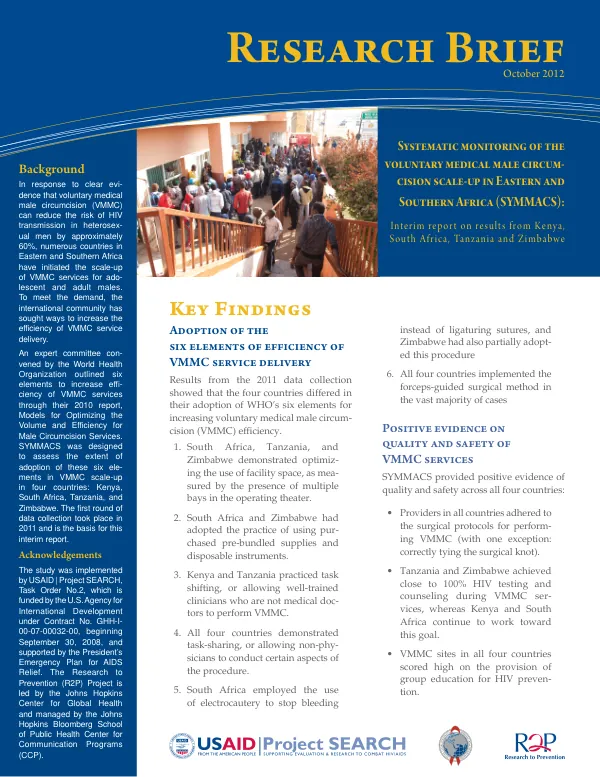
The Systematic Monitoring of the Male Circumcision Scale-up in Eastern and Southern Africa (SYMMACS) is a research project aimed at evaluating the implementation and effectiveness of voluntary medical male circumcision (VMMC) programs in four countries: Kenya, South Africa, Tanzania, and Zimbabwe.
2012 · 138 pages
Sign in to readA free account is required to download.
Abstract
The project is funded by the U.S. Agency for International Development (USAID) under the President's Emergency Plan for AIDS Relief (PEPFAR). The SYMMACS project was initiated in 2010, with the primary objective of assessing the quality of VMMC services, demand creation for VMMC, and the experience and attitudes of VMMC providers. The project also aimed to evaluate the evolution of VMMC programs over time and identify factors influencing the adoption of VMMC. The research methodology involved a mixed-methods approach, combining both quantitative and qualitative data collection and analysis. The project team conducted site visits to VMMC sites in each country, observing male circumcision procedures, assessing the quality of services, and collecting data on demand creation activities. The team also conducted interviews with VMMC providers, clients, and other stakeholders to gather information on their experiences and attitudes towards VMMC. The results of the SYMMACS project indicate that the quality of VMMC services varies across countries and sites. In Kenya, for example, the majority of VMMC sites had adequate surgical beds, information systems, and supervisory mechanisms in place. In contrast, some sites in Tanzania and Zimbabwe lacked essential equipment and supplies. The project also found that demand creation activities, such as mass and small media campaigns, were more effective in promoting VMMC uptake than interpersonal channels. The profile of VMMC providers in each country reveals demographic characteristics, including age, sex, and level of education. In Kenya, for instance, the majority of VMMC providers were male, with a median age of 35 years and a median level of education of secondary school. In South Africa, the majority of providers were female, with a median age of 30 years and a median level of education of tertiary level. The SYMMACS project has several implications for the scale-up of VMMC programs in Eastern and Southern Africa. The findings suggest that improving the quality of VMMC services, enhancing demand creation activities, and providing adequate training and support to VMMC providers are critical to increasing VMMC uptake and reducing the risk of HIV transmission. The project's results also highlight the importance of monitoring and evaluation in ensuring the effectiveness and efficiency of VMMC programs. The SYMMACS project demonstrates the value of systematic monitoring and evaluation in informing policy and program decisions, improving program quality, and ultimately reducing the burden of HIV/AIDS in Eastern and Southern Africa. The SYMMACS project has contributed to the global understanding of VMMC implementation and effectiveness, providing valuable insights for policymakers, program managers, and researchers. The project's findings have informed the development of VMMC guidelines, policies, and programs, and have contributed to the scale-up of VMMC services in Eastern and Southern Africa. The SYMMACS project has also highlighted the importance of collaboration and partnership in achieving the goals of VMMC scale-up. The project's success was made possible through the collaboration of multiple stakeholders, including governments, implementing partners, and research institutions. The project's findings and recommendations have been shared with stakeholders at national, regional, and global levels, promoting a shared understanding of the challenges and opportunities of VMMC scale-up. In conclusion, the SYMMACS project has made significant contributions to the understanding of VMMC implementation and effectiveness in Eastern and Southern Africa. The project's findings have informed policy and program decisions, improved program quality, and contributed to the scale-up of VMMC services in the region. The project's success serves as a model for future research and program implementation, highlighting the importance of systematic monitoring and evaluation, collaboration, and partnership in achieving the goals of VMMC scale-up.