MOH
Tackling gaps throughout Botswana’s health supply chain
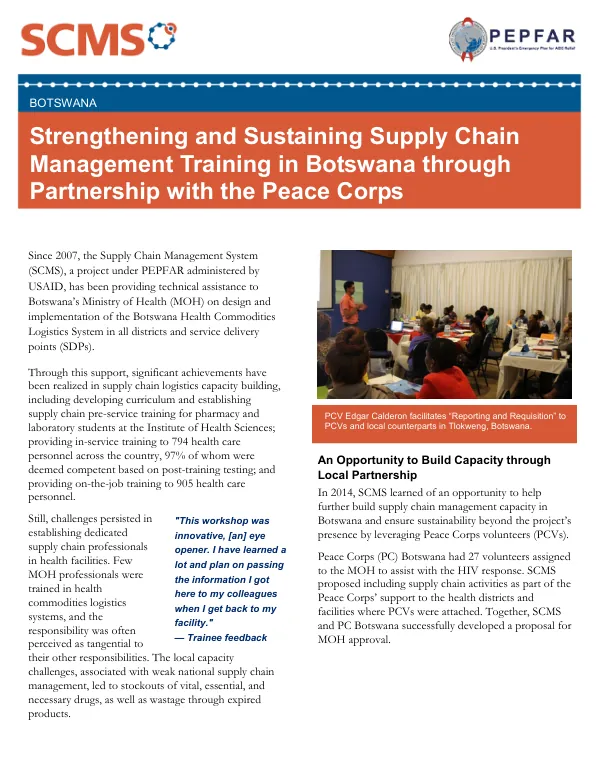
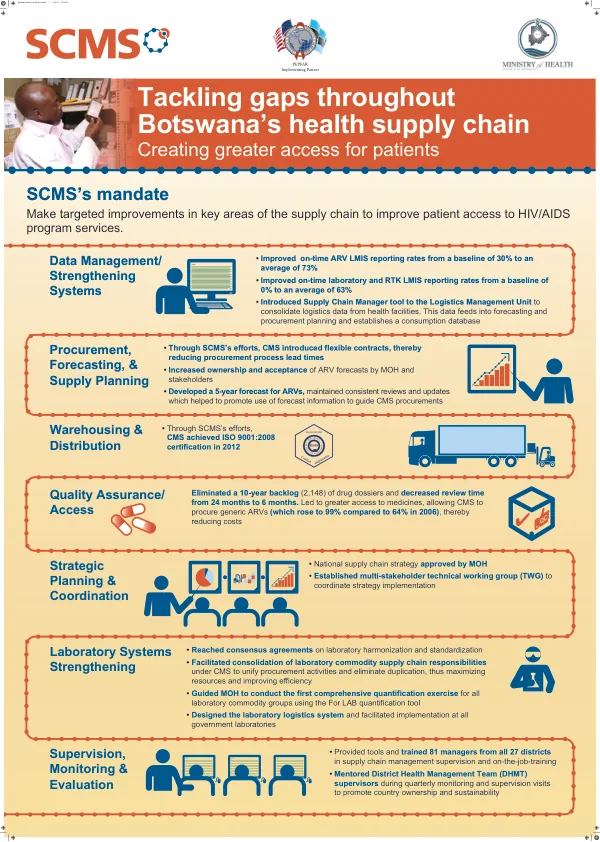
Botswana's health supply chain has undergone significant improvements to enhance patient access to HIV/AIDS program services.
2015 · 1 pages
Sign in to readA free account is required to download.
Abstract
The Supply Chain Management System (SCMS) has been instrumental in making targeted improvements in key areas of the supply chain. One of the primary objectives of SCMS is to strengthen data management systems, which has led to improved on-time reporting rates for Antiretroviral (ARV) Logistics Management Information System (LMIS) and laboratory and Rapid Test Kit (RTK) LMIS. The baseline on-time ARV LMIS reporting rate was 30%, which has increased to an average of 73%. Similarly, the on-time laboratory and RTK LMIS reporting rates have improved from 0% to an average of 63%. To further enhance the supply chain, SCMS has introduced the Supply Chain Manager tool to the Logistics Management Unit. This tool consolidates logistics data from health facilities, which feeds into forecasting and procurement planning, and establishes a consumption database. Additionally, SCMS has promoted the use of flexible contracts, reducing the procurement process lead times. The Ministry of Health (MOH) and stakeholders have increased ownership and acceptance of ARV forecasts, which has led to the development of a 5-year forecast for ARVs. This forecast has been consistently reviewed and updated, promoting the use of forecast information to guide procurements. SCMS has also played a crucial role in improving the quality assurance and access to medicines. The system has eliminated a 10-year backlog of drug dossiers and decreased review time from 24 months to 6 months. This has led to greater access to medicines, allowing the Central Medical Stores (CMS) to procure generic ARVs, which rose to 99% compared to 64% in 2006. The reduction in costs has been significant, and the CMS has achieved ISO 9001:2008 certification in 2012. The national supply chain strategy has been approved by the MOH, and a multi-stakeholder technical working group has been established to coordinate strategy implementation. The group has reached consensus agreements on laboratory harmonization and standardization, and has facilitated the consolidation of laboratory commodity supply chain responsibilities under CMS. This has unified procurement activities and eliminated duplication, maximizing resources and improving efficiency. The MOH has also conducted the first comprehensive quantification exercise for all laboratory commodity groups using the For LAB quantification tool. To promote country ownership and sustainability, SCMS has provided tools and trained 81 managers from all 27 districts in supply chain management supervision and on-the-job-training. The system has also mentored District Health Management Team (DHMT) supervisors during quarterly monitoring and supervision visits. The warehousing and distribution systems have been improved, and the laboratory logistics system has been designed and implemented at all government laboratories.