USAID DEC
National Supply Chain Strategy for Botswana
The National Supply Chain Strategy for Botswana was developed through a collaborative effort among stakeholders.
2015 · 13 pages
Sign in to readA free account is required to download.
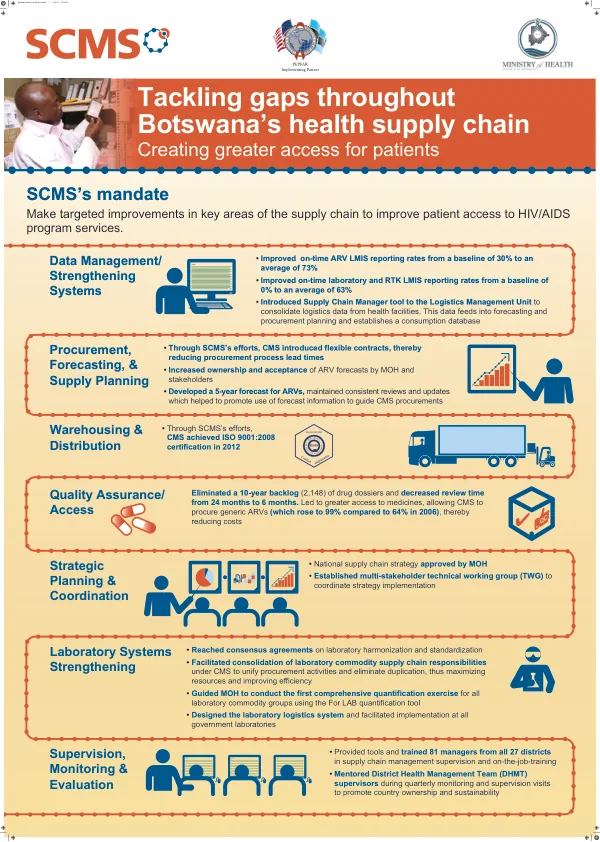
Abstract
A stakeholder workshop was held in March 2014, guided by findings from pre-workshop interviews, results from the 2013 National Supply Chain Assessment, and deliberations from the workshop. The strategy aligns with six goals of the Ministry of Health's Business Strategy Committee (MOH BSC): access to health, quality of service, supply chain management, operational excellence, performance-oriented culture, and optimal use of resources. The strategy addresses supply chain functions, including product selection and use, forecasting and supply planning, procurement, warehousing and distribution, logistics management information, and human resources and management. The strategy aims to establish a system for developing, reviewing, and enforcing policies and guidelines governing product selection and use. This includes updating treatment guidelines and essential drug lists, engaging the Department of Policy Development, Monitoring & Evaluation on morbidity information, and promoting research to inform selection. Forecasting and supply planning strategies focus on building and sustaining technical capacity to prepare forecasts and supply plans across all program areas. This includes sustaining pre- and in-service training on logistics management information systems (LMIS) and data quality management, issuing a national policy requiring universal adherence to an integrated LMIS reporting process, and forming forecasting technical working groups for malaria, TB, essential medicines, and lab supplies. Procurement strategies aim to ensure a flexible and responsive function for procuring high-quality, low-cost medicines, medical supplies, and lab equipment. This includes developing a national policy for the procurement of drugs and related substances, hiring and training contract management staff, and establishing a list of preferred technical advisors who can be contracted as needed. The strategy also aims to empower locals to start manufacturing or vendor companies and optimize laboratory procurements by examining the total cost of equipment lease versus purchase. Warehousing and distribution strategies focus on ensuring a flexible and responsive function for procuring high-quality, low-cost medicines, medical supplies, and lab equipment for availability and support their efficient and secure movement throughout the supply chain. This includes including adequate cold chain capacity in distribution contract requirements, improving physical security at all facilities, and modifying the LMIS report to serve as a requisition form. Quality assurance strategies aim to establish and maintain functional MOH capacity for approving new health products and monitoring the quality of existing health products. This includes asserting product quality in the MOH corporate strategy, establishing a medicines regulatory authority (MRA), increasing laboratory equipment, inspections, maintenance, and training, and improving cold chain monitoring. Logistics management information strategies focus on establishing and maintaining a functional system for collection and analysis of supply chain data for decision-making. This includes ensuring adequate LMIS training and monitoring, introducing prescription slips at facilities, and reducing administrative burden by reviewing reporting requirements and streamlining the process. Human resources and management strategies aim to clarify and align roles, responsibilities, and performance measures of stakeholders at all levels of the supply chain system. This includes conducting a system-wide workload assessment, establishing and/or enhancing in-service and pre-service training programs, developing a human resource sustainability policy and plan, and enforcing personal development plans and rewarding supply chain performance.