TNC
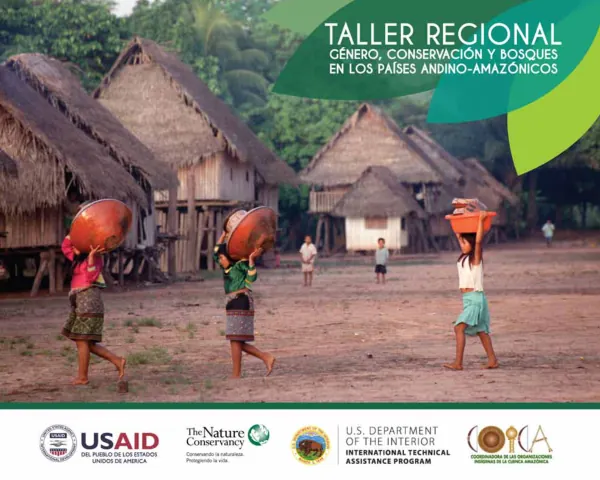
Taller Regional Género, Conservación y Bosques en los Países Andino-Amazónicos
The regional gender, conservation, and forests conference in the Andean-Amazonian countries took place on August 9 and 10, 2012, in Bogotá, Colombia.
2012 · 152 pages
Sign in to readA free account is required to download.
Abstract
The conference focused on the importance of considering gender in the conservation, management, and sustainable use of forests. Women and men from indigenous and local communities possess different traditional knowledge about how to use and approach forests, and the deforestation and climate change affect them in distinct ways. The conference aimed to address the lack of representation and voice of women in decision-making processes related to forest conservation. The event brought together women and men from six indigenous organizations in Peru, Ecuador, and Colombia, as well as international organizations, NGOs, and Colombian state entities. The conference agenda included presentations by experts and representatives of indigenous communities, as well as discussions in working groups on topics such as traditional knowledge, consultation, and distribution of benefits, and the impacts of extractive activities on forests. The conference objectives were to complement and consolidate a regional baseline in Colombia, Ecuador, and Peru on experiences of conservation, management, and sustainable use of forest resources, and to define a regional strategy for integrating gender into the activities of the Net Zero Deforestation project. The conference aimed to explore the perceptions of women on conservation, the forest, and related topics, and to identify indicators sensitive to gender that could be useful in constructing policies and actions that take into account the needs, interests, and demands of women. The conference was coordinated by experts in the field, who facilitated discussions and presented a series of questions to guide the debate. The conference also included the presentation of experiences from indigenous communities in Peru, Ecuador, and Colombia, as well as the presentation of papers by experts on topics such as traditional knowledge, sustainable forest management, and the protection of indigenous territories. The conference resulted in the development of a regional strategy for integrating gender into the activities of the Net Zero Deforestation project, as well as the identification of indicators sensitive to gender that could be useful in constructing policies and actions that take into account the needs, interests, and demands of women. The conference also contributed to the consolidation of a regional baseline on experiences of conservation, management, and sustainable use of forest resources. The conference was attended by women and men from indigenous and local communities, as well as international organizations, NGOs, and Colombian state entities. The conference provided a platform for the exchange of experiences and knowledge, and for the discussion of topics related to forest conservation and sustainable use. The conference also contributed to the development of a regional strategy for integrating gender into the activities of the Net Zero Deforestation project. The conference resulted in the development of a regional strategy for integrating gender into the activities of the Net Zero Deforestation project, as well as the identification of indicators sensitive to gender that could be