CONSERVATION STRATEGY FUND
Initiative for Conservation in the Andean Amazon (ICAA II)
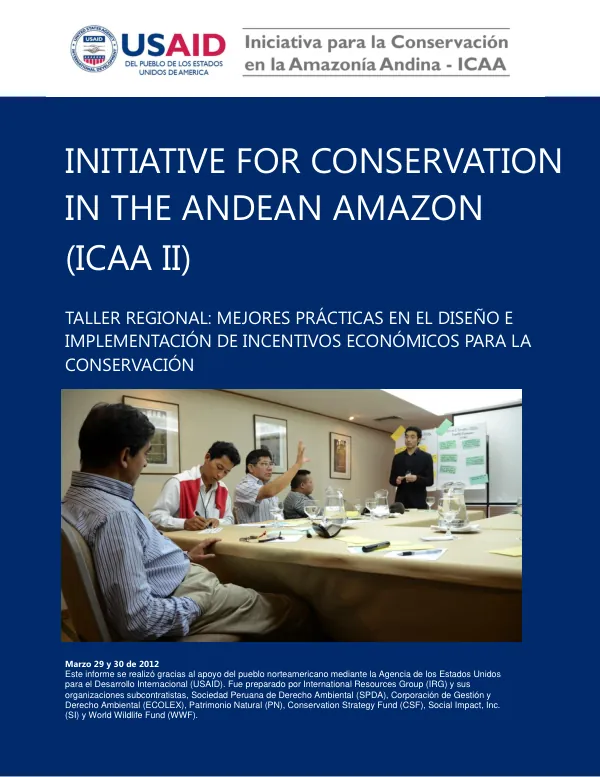
The Initiative for Conservation in the Andean Amazon (ICAA II) is a regional workshop focused on identifying best practices in the design and implementation of economic incentives for conservation.
2012 · 52 pages
Sign in to readA free account is required to download.
Abstract
The workshop was held in Lima, Peru, on March 29 and 30, 2012, and was organized by the Support Unit of the ICAA, with the support of the United States Agency for International Development (USAID). The workshop brought together key actors from Bolivia, Colombia, Ecuador, Peru, and Brazil, as well as from Mexico and Costa Rica, related to this type of programs. These actors included government officials, indigenous people representatives, experts, and academics. The workshop highlighted the importance of considering the Amazon region as a strategic global area due to its provision of various environmental services. The Amazon region provides four key environmental services: (1) carbon sequestration and storage, (2) conservation of biodiversity and genetic resources, (3) regulation of the global hydrological cycle, and (4) source of traditional knowledge. However, a significant challenge in this context is the valuation of ecosystems and the services they provide. In Latin America, there are several years of successful experiences and learning in the use of payment for environmental services (PES) and other economic incentives for conservation. These experiences have led to some considerations for the design of these programs, including the need to review and adapt institutional frameworks, legal frameworks, and policies; clarify land tenure and rights to use and exploit environmental goods and services; and foster the role of the state as a facilitator. Additionally, it is essential to articulate programs of incentives with measures of "command and control" and link them to national, sub-national, and other planning processes, such as community life plans of indigenous peoples. The design should also incorporate local context characteristics, cultural aspects, including gender and social equity, and recognize that the implementation of programs of economic incentives for conservation is a slow process (not less than 3-4 years). The workshop also emphasized the importance of transferring relevant information to the public through a solid and constant process, taking into account cultural aspects when working with indigenous communities. It is also essential to use existing information, guarantee a solid monitoring system, and promote the use of standards and best practices as a guarantee for those involved. Furthermore, it is necessary to diversify funding sources to achieve sustainability and strengthen local institutions. The workshop highlighted the importance of adapting the implementation mechanism to local conditions, recognizing the existence of various options. It also emphasized the need to strengthen capacities to characterize and value environmental services and establish the link between ecosystem conservation and service provision. Additionally, it is essential to establish areas of eligibility and define the scope of the program, as well as to establish a link with the private financial sector. The workshop concluded that the implementation of economic incentives for conservation is a complex process that requires careful consideration of various factors, including institutional frameworks, legal frameworks, policies, and local context characteristics. It also emphasized the importance of transferring relevant information to the public, using existing information, and promoting the use of standards and best practices.
Related documents
Documents in this collection
 2014
2014USAID DEC
Informe de Consultoría: Orientación, Implementación y Ajuste de Incentivos Fiscales y Monetarios de la Amazonia Andina Colombiana
Open record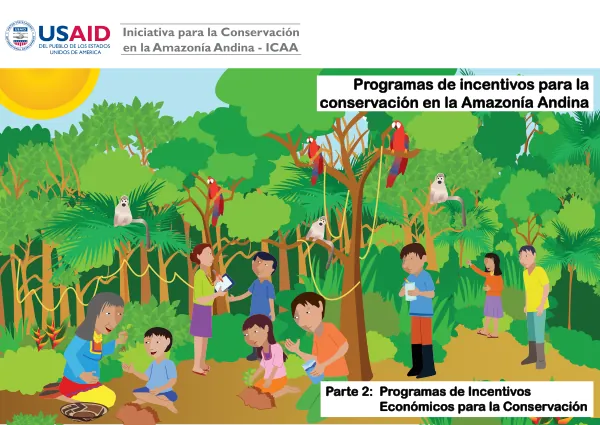 2013
2013USAID DEC
Programas de incentivos para la conservación en la Amazonía Andina Parte 2: Programas de Incentivos Económicos para la Conservación
Open record