USAID DEC
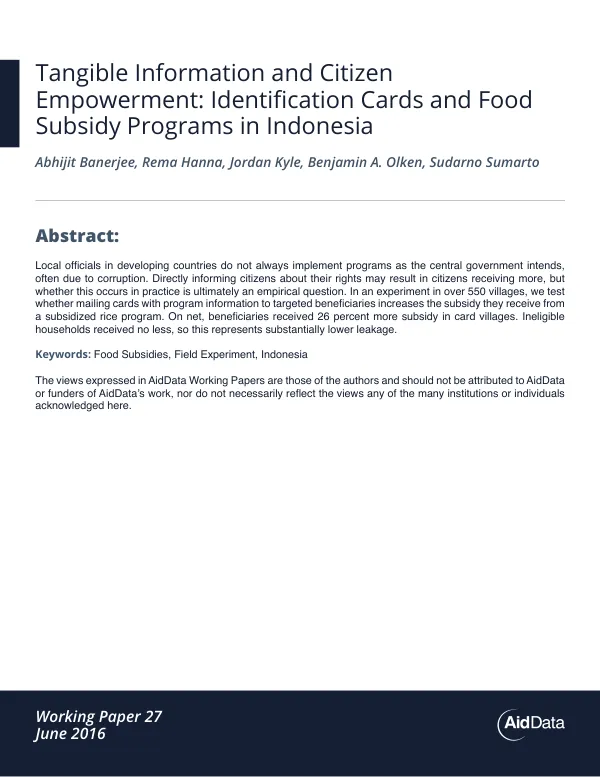
Tangible and Citizen Empowerment: Identification Cards and Food Subsidy Programs in Indonesia
Sign inBANK FOR WEST AFRICAN DEVELOPMENT
Tangible and Citizen Empowerment: Identification Cards and Food Subsidy Programs in Indonesia
In developing countries, local officials often implement programs differently than the central government intends, often due to corruption.
2016 · 45 pages
Sign in to readA free account is required to download.
Abstract
Directly informing citizens about their rights may lead to citizens receiving more, but whether this occurs is an empirical question. An experiment in over 550 villages tested whether mailing cards with program information to targeted beneficiaries increases the subsidy they receive from a subsidized rice program. Beneficiaries in card villages received 26% more subsidy on average, with ineligible households receiving no less. This represents lower leakage, as ineligible households received no less. The experiment also tested the impact of an additional piece of information on the effectiveness of the program. The results suggest that providing citizens with more information can lead to better service delivery. However, the effectiveness of this approach depends on various factors, including the type of information provided and the level of citizen engagement. The study highlights the importance of considering the potential unintended consequences of providing citizens with more information. In many developing countries, governments face the challenge of ensuring that their rules and laws are implemented as intended. Local officials often have their own interests, which can lead to policies and programs being implemented differently than the government's intentions. This can result in citizens receiving different benefits than those intended by the government. A local official administering a government transfer program, such as a subsidized food program or a workfare scheme, may have substantial leeway in how they implement the program. Citizens may challenge the official if they believe they have been cheated, but it is difficult to do so without a full understanding of the official rules. Many advocate for providing citizens with greater information about their rights under different programs in order to improve service delivery. However, it is unclear whether providing citizens with more information will actually matter. Citizens may not be able to use the information to demand more of their local leaders, or local leaders may not care about citizen demand. Additionally, providing more information may make things worse by reducing the possibility of illicit rents, motivating local officials to steal more. Despite the importance of this topic, there has been relatively little empirical research on the question of whether providing citizens with more information leads to better service delivery. A few studies have examined the effects of providing just information, particularly for services where the government is the monopoly provider. One study found that a community-monitoring program that brought together community members and healthcare providers to discuss health centers and create an action plan for change led to large improvements in health outcomes. Another study found an association between median access and leakages in the expenditures in Madagascar. A third study found that a 25-minute video on a workfare program shown in 40 villages in India led to a 25% increase in the number of participants.