USAID DEC
Tanzania Human Resource Capacity Project Progress Report on MCV Program using Para-social Worker Model
Sign inAFRICARE, INC.
Tanzania Human Resource Capacity Project Progress Report on MCV Program using Para-social Worker Model
The Tanzania Human Resource Capacity Project (THRP) MVC Program is a collaborative effort between the THRP, key stakeholders, and local government authorities to address the shortage of social welfare officers at the village level.
2011 · 10 pages
Sign in to readA free account is required to download.
Abstract
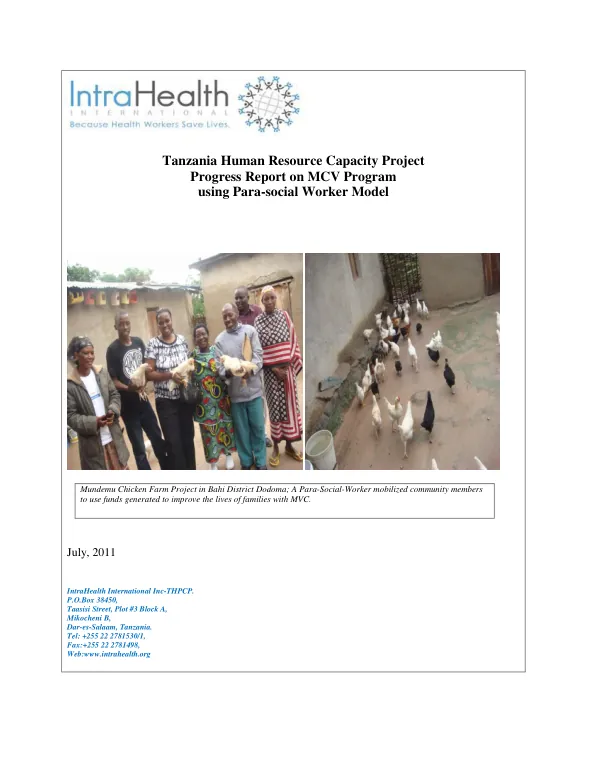
The program aims to train and mainstream a new volunteer cadre of para-professional social workers (PSWs) into the existing local government structure. The THRP MVC program is implementing the PSW Model, which consists of four main components: Partnership, LGA Advocacy, PSW Training, and Monitoring and Evaluation. During the current implementation year, the program has conducted joint partnership planning of activities, mentored and coached new PSW actors, and conducted quarterly district and community level follow-up visits for advocacy activities in Dodoma and Mwanza regions. The program has trained over 3000 Para-social workers in the second phase, with a total of 617 PSWs trained in Iringa and 983 PSWs trained in Mwanza region from January 2011 to June 2011. The program has also conducted two regional awareness meetings in Mwanza in 2009 and in Iringa in 2011, with all key department heads in attendance. Each district formed MVC teams for advocacy in Dodoma and Mwanza, and the program facilitated and supported the formation of PASONET, the PSWs' Network, in Dodoma region and in Mwanza. The program has also conducted quarterly district and community level follow-up visits for data collection in Dodoma and Iringa, and provided feedback to district Executive Directors and Head of departments. Various data has been collected and shared with critical government stakeholders for the purpose of establishing a compelling case and lobbying for more resources for MVC services. Monitoring and evaluation has been conducted to assess the progress made by PSW trainees and PSW supervisors in delivering basic services to MVCs at village and ward levels. The findings from the monitoring and evaluation follow-up in Dodoma region indicate that the PSWs have been able to identify children in risky and vulnerable situations and link them with services such as schools. The PSWs have also been able to mobilize community members to use funds generated to improve the lives of families with MVC. The program has also identified the need for enhancing collaboration with NGOs supporting MVC, implementing a co-funding strategy, educating village/ward leaders on their role to support MVCs, working with community to increase their awareness on their responsibilities to support MVCs, establishing guidelines for implementing community funds, providing PSWs with working tools, and using Regional Social Welfare Officers for continuous follow-up, mentoring, and coaching for supervisors at district level. The program has also suggested that District Social Welfare Officers sensitize Para-social workers to join PASONET, improve communication and support between Advocacy teams and village/ward leaders to PSWs in supporting MVC, inform influential people and request their support for MVC in the respective areas, and that MVC Advocacy Teams in collaboration with PSWs sensitize the community on formulation of MVC committee, raise funds to support MVC, and concurrently use PASONET to explore other external sources of resources.
Related documents