USAID DEC
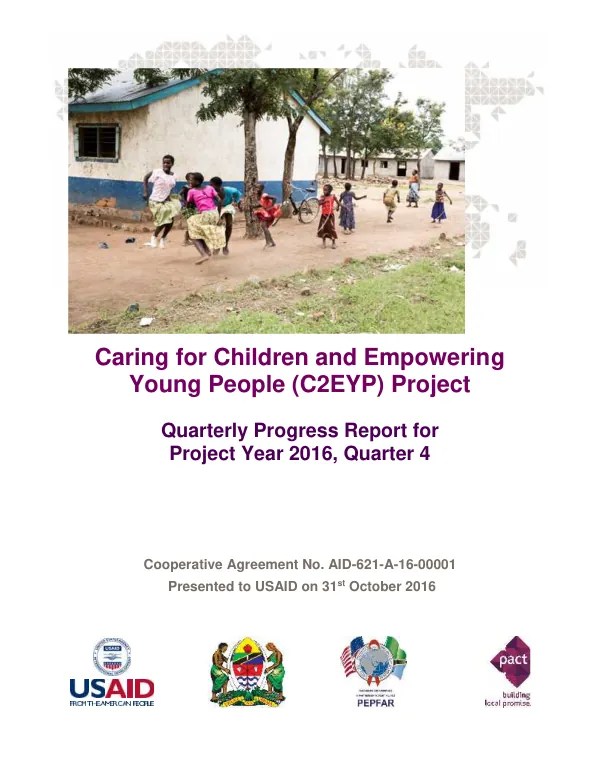
Caring for Children and Empowering Young People (C2EYP) Project Quarterly Progress Report for Project Year 2016, Quarter 4
Sign inAGA KHAN FOUNDATION
Caring for Children and Empowering Young People (C2EYP) Project Quarterly Progress Report for Project Year 2016, Quarter 4
The Caring for Children and Empowering Young People (C2EYP) project is a five-year initiative implemented by Pact in partnership with various organizations, including the Aga Khan Foundation, Elizabeth Glaser Pediatric AIDS Foundation, and Ifakara Health Institute.
2016 · 30 pages
Sign in to readA free account is required to download.
Abstract
The project aims to enable one million Tanzanian orphans and vulnerable children (OVC) and young people affected by HIV to utilize age-appropriate HIV-related and other services for improved care, health, nutrition, education, protection, livelihoods, and psycho-social well-being. The project is funded by the President's Emergency Plan for AIDS Relief (PEPFAR) through the United States Agency for International Development (USAID). C2EYP collaborates with civil society organizations (CSOs), the Government of Tanzania, and other stakeholders to achieve its goal. In its first year, the project will cover 84 scale-up and 62 sustained councils across 28 regions. Tanzania has made significant gains in human development, including a 7% economic growth rate over the past decade and a decline in HIV prevalence from 7% in 2004 to 5.1% in 2012. However, deep inequities and vulnerabilities persist, with HIV prevalence rates varying across regions and an estimated 3.2 million OVC. Family is the foremost protective asset for children, but poverty and disease undermine families' capacity to care for children. The project has secured offices in all six clusters and recruited key personnel, including a Senior Technical Advisor and other technical and program staff. Pact has also conducted risk assessments of Pamoja Tuwalee CSOs to identify financial, administration, and management risks and instituted risk mitigation according to the findings. The project has conducted high-level meetings with stakeholders to get buy-in and ensure coordination. Pact and the C2EYP consortium partners have drafted the project work plan, which was presented to a team from USAID-Tanzania and Washington DC. The project received feedback to further align the plan with national and global priorities and strategies. The due date for the Year 1 work plan was extended from October 4th to October 19th 2016. The project aims to achieve its goal through various interventions, including saving groups and modalities of working with community volunteers. Pact has conducted meetings with implementing partners to ensure smooth transitioning of OVC to the C2EYP project and to avoid service interruption. The project has also conducted geographical coverage and beneficiaries' data verification, views on CSO's ability to implement the project during the bridge funding period, and specific concerns and highlights for each sub-national unit. The project has made significant progress in its first quarter, including securing offices, recruiting key personnel, and conducting risk assessments. The project is ready to begin implementation at the sub-national level in the coming quarter. The project has also conducted high-level meetings with stakeholders to get buy-in and ensure coordination. The project's geographic coverage includes 84 scale-up and 62 sustained councils across 28 regions. The project aims to cover one million OVC and young people affected by HIV. The project's interventions include saving groups, modalities of working with community volunteers, and other services for improved care, health, nutrition, education, protection, livelihoods, and psycho-social well-being. The project's progress is monitored through a performance monitoring plan (PMP). The project's risk assessment has identified financial, administration, and management risks, which have been mitigated through various interventions. The project has also conducted high-level meetings with stakeholders to get buy-in and ensure coordination. The project's next steps include implementing the project work plan, which was drafted by Pact and the C2EYP consortium partners. The project will continue to collaborate with CSOs, the Government of Tanzania, and other stakeholders to achieve its goal. The project will also continue to monitor its progress through the PMP and address any risks that may arise.
Related documents