DAI GLOBAL, LLC
TAQARIB (LGCS) – ACTIVITY FY 2021 Q2 QUARTERLY REPORT
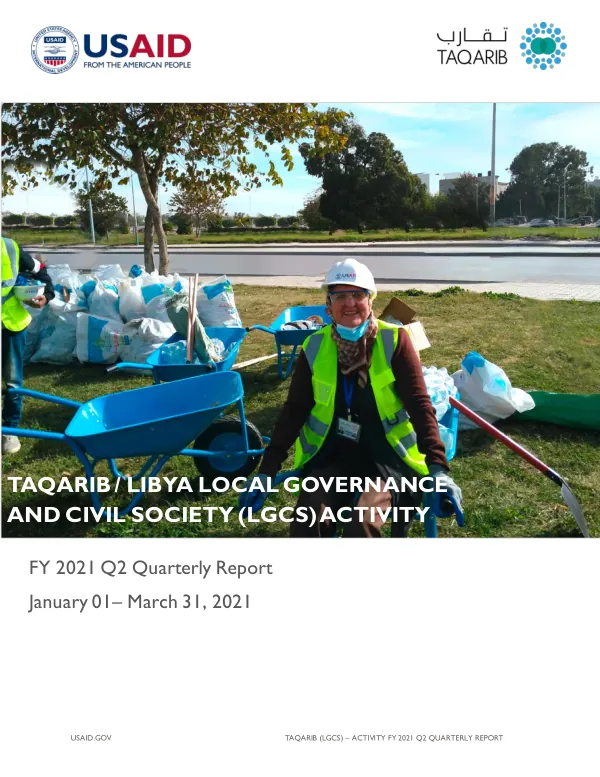
The Libya Local Governance and Civil Society Activity, also known as Taqarib, is a program implemented by DAI Global LLC under a cooperative agreement with the United States Agency for International Development (USAID).
2021 · 86 pages
Sign in to readA free account is required to download.
Abstract
The program aims to strengthen the foundations of the Libyan state by helping municipalities improve local service delivery with maximum public participation. The program's objectives are fourfold. Objective 1 focuses on strengthening the capacity of targeted municipal institutions to deliver services and be more responsive to citizen needs. This includes the Municipal Performance Index (MPI), local government professionalization, the Visible Improvement Service Process (VIS), peer-to-peer learning and alumni network, and COVID-19 response. Objective 2 builds the capacity of citizens, civil society organizations (CSOs), private sector actors, and other formal and informal stakeholders to advocate and hold municipal and related national-level institutions accountable for delivering on their mandates. This includes the Organizational Performance Index (OPI), Champions for Change, citizen participation in planning, micro-research and polling, and social accountability tools. Objective 3 strengthens national and sub-national decentralization policies, systems, and coordination. This includes comprehensive local government policy diagnostics and functional reviews, support for national strategy meetings on local governance issues, law 59 implementation and reforms, and pilot decentralization service delivery initiatives. Objective 4 informs programming through a robust learning and analysis agenda (MEL). This includes quarterly perception surveys, quarterly strategy review sessions (SRS), an annual journey to self-reliance study, and a web-based knowledge-management and learning platform. During the second quarter of FY 2021, Taqarib partner municipalities signed 1.1 non-binding implementation agreements, conducted 1.2 MPI assessments, and supported 1.3 VIS processes. Additionally, 1.7 municipality-led multi-stakeholder events were held, and 1.8 individuals participated in peer-to-peer learning exchanges. Taqarib also supported 1.9 COVID-19 preparedness and/or response plans in various phases. In terms of Objective 2, 2.1 CSOs received USG assistance and engaged in advocacy activities, and 2.2 OPI baseline assessments were conducted with CSOs. Furthermore, 2.4 CSO-led multi-stakeholder events were held as part of municipal service-delivery processes, and 2.5 grants were awarded to advocate for or hold government institutions accountable. For Objective 3, 3.1 public policies were introduced, adopted, repealed, changed, or implemented with citizen input, and 3.2 multi-stakeholder dialogues were held among national actors about the decentralization agenda. Additionally, 3.3 decentralized business processes were mapped and analyzed. Taqarib's implementation principles emphasize direct benefits, a public health response, doing no harm, making municipalities the principle partners, and appreciating what already works. The program's purpose is to strengthen the foundations of the Libyan state by helping municipalities improve local service delivery with maximum public participation.