USAID DEC
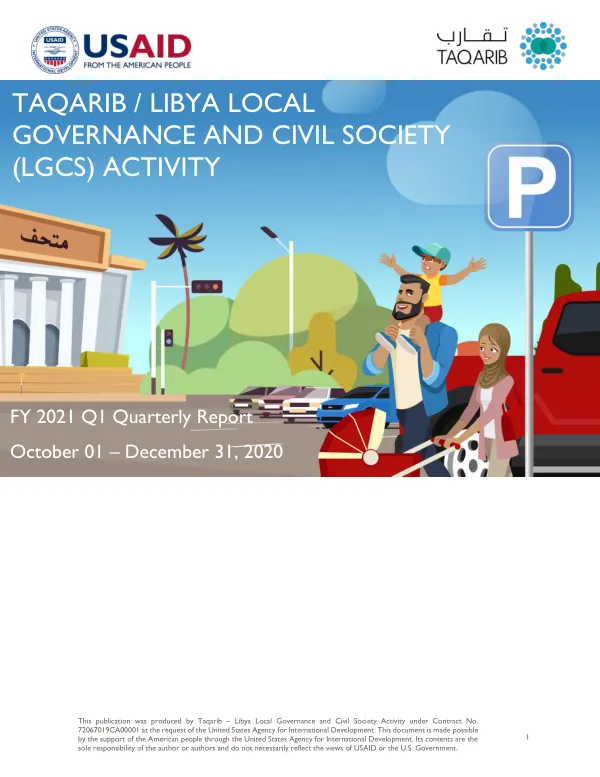
FY 2021 Q1 Quarterly Report: TAQARIB / LIBYA LOCAL GOVERNANCE AND CIVIL SOCIETY (LGCS) ACTIVITY
Sign inDAI GLOBAL, LLC
FY 2021 Q1 Quarterly Report: TAQARIB / LIBYA LOCAL GOVERNANCE AND CIVIL SOCIETY (LGCS) ACTIVITY
The Taqarib – Libya Local Governance and Civil Society Activity is a project implemented by DAI Global, LLC under Contract No.
2021 · 66 pages
Sign in to readA free account is required to download.
Abstract
72067019CA00001 with the United States Agency for International Development. The project aims to strengthen the capacity of targeted municipalities to deliver services and be more responsive to citizen needs. The project has four main objectives: Objective 1 focuses on strengthening the capacity of targeted municipal institutions to deliver services and be more responsive to citizen needs. This includes the Municipal Performance Index (MPI), local government professionalization, Visible Improvement Service Process (VIS), peer-to-peer learning and alumni network, and COVID-19 response. Objective II builds the capacity of citizens, civil society organizations, private sector actors, and other formal and informal stakeholders to advocate and hold municipal and related national-level institutions accountable to delivering on their mandates. This includes the Organizational Performance Index (OPI), youth, minority, and women leadership training, citizen participation in planning, micro-research and polling, and social accountability tools. Objective III aims to strengthen national and sub-national decentralization policies, systems, and coordination. This includes comprehensive local government policy diagnostics and functional reviews, support for national strategy meetings on local governance issues, implementation and evaluation of pilot decentralization service delivery initiatives, strengthening central-municipal communication and coordination, and national advocacy platforms and CSOs support for the local governance agenda. Objective IV focuses on informing programming through a robust learning and analysis agenda (MEL), including quarterly perception surveys, quarterly strategy review sessions, annual journey to self-reliance study, and a web-based knowledge-management and learning platform. During the FY21Q1 quarter, Taqarib staff worked across departments to carry Year 1 service delivery commitments to the finish line and maintain strong momentum with stakeholders into the second year of the project. The team implemented 12 community-based volunteer events with the participation of 211 volunteers, more than 29 virtual trainings, workshops, and dialogues with 397 participants, 4 public consultations, and 1 policy championed and adopted by 13 municipal partners. However, the project faced challenges due to the persistence of COVID-19, including office closures, curfews, and the closure of borders between municipalities. The project staff took the opportunity to reflect on the events of the year and work with within the team and with partners to ensure that precious lessons learned will be captured and judiciously applied. Mid-term evaluations, along with Year 2 public consultations, allowed Taqarib and the municipal partner to more strategically determine their service delivery enhancement needs and priorities for Year 2 Citizen Charters. The team conducted 16 trainings around the safety of municipal staff and 26 trainings on capacity building around the establishment of the Emergency Operations Centers (EOC), in addition to ongoing mentorship and consulting for 3 municipalities on the set-up and operation of the EOC. The project also coordinated or implemented 8 community clean-up events and 3 Garbage Monster book distribution events, and delivered equipment to 8 partner municipalities. The 2021 municipal elections were underway in FY21Q1, and the Objective team prepared transition scenarios for the Year 2 work plan. Taqarib's Public Participation Objective was the most visibly impacted by the constraints to operations, but the team adapted to virtual meetings and trainings to maintain momentum with stakeholders. The project has made significant progress in implementing its objectives, despite the challenges posed by the COVID-19 pandemic. The team has worked tirelessly to ensure that the project's commitments are met, and that the lessons learned will be captured and applied to inform the project's future work. The project's focus on strengthening the capacity of targeted municipalities to deliver services and be more responsive to citizen needs remains a key priority, and the team is committed to continuing this work in the coming year.