USAID DEC
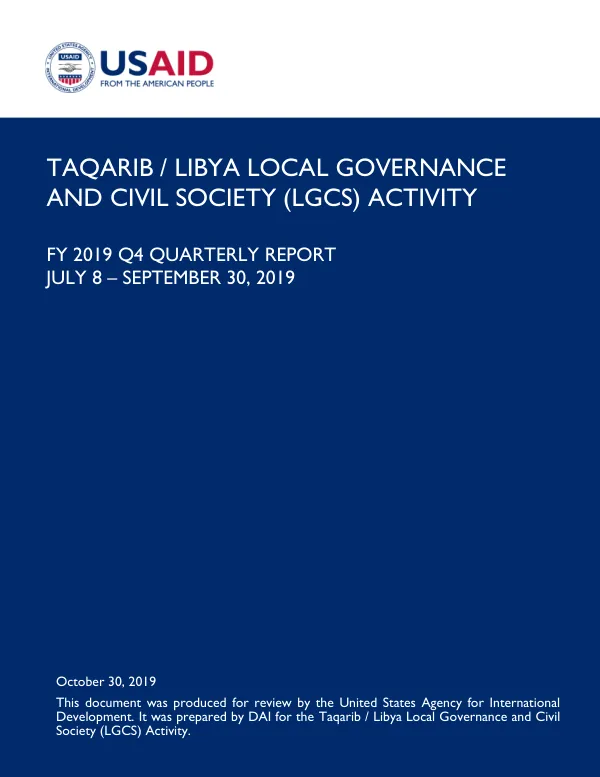
TAQARIB / LIBYA LOCAL GOVERNANCE AND CIVIL SOCIETY (LGCS) ACTIVITY FY 2019 Q4 QUARTERLY REPORT
Sign inDAI GLOBAL, LLC
TAQARIB / LIBYA LOCAL GOVERNANCE AND CIVIL SOCIETY (LGCS) ACTIVITY FY 2019 Q4 QUARTERLY REPORT
Taqarib / Libya Local Governance and Civil Society (LGCS) Activity mobilized long-term personnel and established platforms in Tunis, Tripoli, and Benghazi.
2019 · 16 pages
Sign in to readA free account is required to download.
Abstract
Initial project deliverables, including the Rapid Mobilization Plan and the Year One Implementation Plan, were submitted to USAID. The project selected six partner municipalities: Tripoli Center, Benghazi, Bani Walid, Sebha, al-Baida, and Zliten. Contextual analysis and stakeholder engagements were conducted, and coordination meetings with other organizations were held. Under Objective 1, the Municipal Performance Index (MPI) tool was customized, and the VIS process was developed. The project provided information on the MPI approach to national stakeholders and conducted on-the-ground assessments in partner municipalities. The goal of the VIS process is to improve municipal services and responsiveness to citizen needs. Under Objective 2, CSO mapping activities were conducted, and the Organizational Performance Index (OPI) tool was customized. The project engaged with prominent Libyan CSOs to validate previous assessments and drafted the Annual Program Statement and requests for applications (RFA). The objective is to build the capacity of citizens, civil society organizations, and private sector actors to advocate and hold municipal and national institutions accountable. Under Objective 3, the High Council for Local Governance (HCLG) was briefed on the MPI tool and the VIS methodology. A legal analysis of the service-contract template was conducted, and potential collaboration points with the Libya Public Financial Management (LPFM) activity were explored. Decentralization policy and source revenue opportunities were also discussed. Under Objective 4, the project developed and submitted the draft AMELP, outlining methods, approaches, and tools for monitoring and learning. The project also submitted reports to USAID, including political and economic updates and municipality spotlights. The goal is to inform programming through a learning and analysis agenda. The project has established a strong presence in Libya, with offices in Tunis, Tripoli, and Benghazi. The team has conducted contextual analysis, engaged with stakeholders, and coordinated with other organizations. The project has also customized tools, such as the MPI and OPI, and has begun implementing the VIS process and VIS process is to improve municipal services and responsiveness to citizen needs. The project has made significant progress in its first quarter, with the selection of partner municipalities, contextual analysis, and stakeholder engagements. The project has also developed and submitted initial project deliverables, including the Rapid Mobilization Plan and the Year One Implementation Plan. The project's goal is to strengthen municipal institutions and build the capacity of citizens, civil society organizations, and private sector actors to advocate and hold municipal and national institutions accountable.
Related documents