USAID DEC
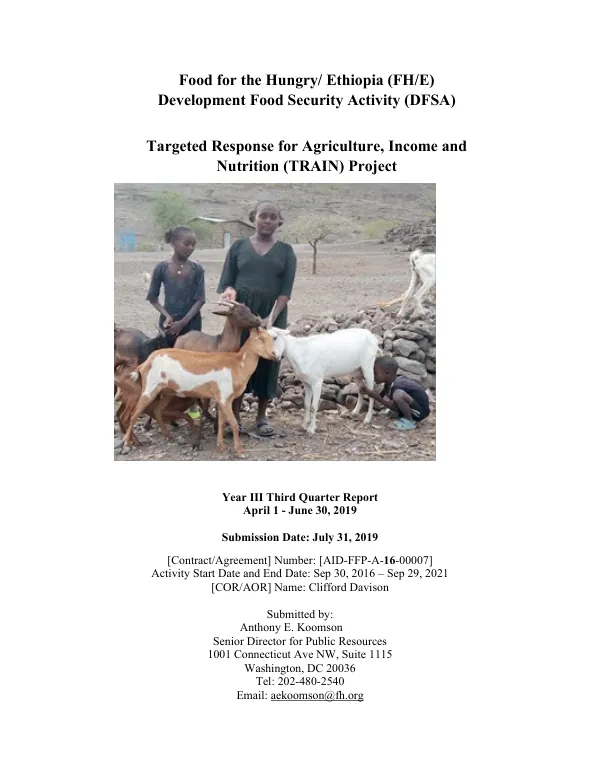
Targeted Response for Agriculture, Income and Nutrition (TRAIN) Project Year 2 Second Quarter Report
Sign inAMHARA DEVELOPMENT ASSOCIATION
Targeted Response for Agriculture, Income and Nutrition (TRAIN) Project Year 2 Second Quarter Report
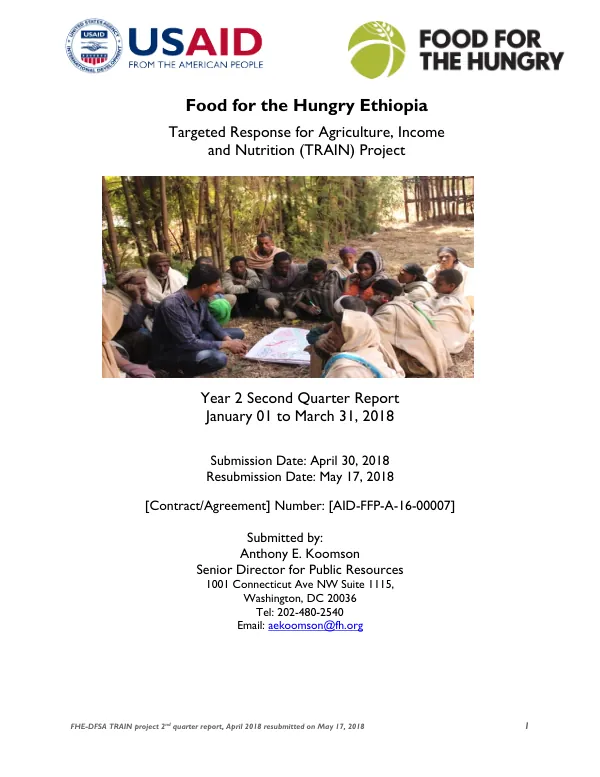
The Targeted Response for Agriculture, Income, and Nutrition (TRAIN) project is a development initiative implemented in seven chronically food insecure woredas of Amhara Regional state, Ethiopia.
2018 · 40 pages
Sign in to readA free account is required to download.
Abstract
The project aims to improve food security, income, and nutrition outcomes for vulnerable households. The TRAIN project is operational from September 30, 2016, to September 29, 2021, and is implemented by Food for the Hungry Ethiopia (FHE) as the prime implementing partner. The project focuses on seven districts: Lay Gayint, Tach Gayint, Sedi-Muja, Simada, Abergele, Sahila, and Ziquala. Additionally, Ebinat and Meketewa (South Gondar zone) and East Belesa (North Gondar zone) were included as expansion woredas for food distribution only. The project's geographic coverage spans the Amhara Regional State, with a focus on improving agricultural productivity, income, and nutrition outcomes for vulnerable households. The TRAIN project is implemented in collaboration with various stakeholders, including Amhara Credit and Saving Institution (ACSI), Amhara Development Association (ADA), and Search for Common Ground (SFCG). The project's major counterpart organizations include regional, zonal, and district-level government line offices. The project's reporting period covers January 1 to March 31, 2018. Implementation of the TRAIN project has been ongoing, with various activities implemented during the second quarter of 2018. The project's implementation progress is reported in the following sections. The project's collaboration, learning, and adaptation (CLA) activities are also highlighted, along with implementation challenges and monitoring and evaluation updates. The TRAIN project has made significant progress in implementing its activities, including the facilitation of kebele DRR committee members to conduct assessments, the establishment of demonstration plots, and the provision of training to farmers on sustainable agriculture practices. The project has also made progress in implementing its livelihood transfer (LT) targeting process, with a focus on improving the livelihoods of vulnerable households. The project's integration of cross-cutting issues and USAID forward priorities is also highlighted, with a focus on gender equality and female empowerment, sustainability mechanisms, environmental compliance, global climate change, policy and governance support, and local capacity development. The project's stakeholder participation and involvement are also reported, with a focus on engaging with local communities and stakeholders to ensure the project's relevance and effectiveness. The TRAIN project has also made progress in implementing its management and administrative activities, including the submission of financial reports and the provision of updates on project implementation. The project's lesson learned section highlights the importance of collaboration, learning, and adaptation in project implementation. The project's planned activities for the next quarter, including upcoming events, are also reported. The project's financial management is also highlighted, with a focus on ensuring the effective use of project resources. Overall, the TRAIN project has made significant progress in implementing its activities and achieving its objectives, with a focus on improving food security, income, and nutrition outcomes for vulnerable households in Amhara Regional state, Ethiopia.