USAID DEC
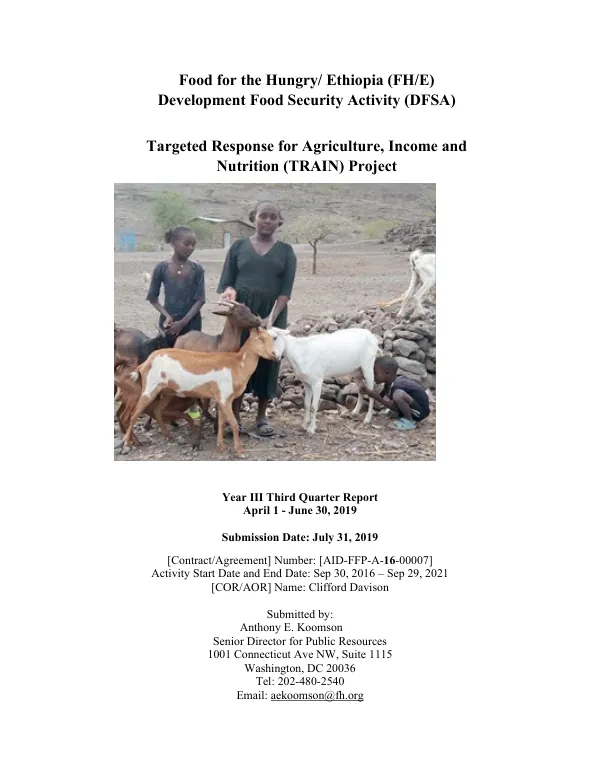
Year III Third Quarter Report: Targeted Response for Agriculture, Income and Nutrition (TRAIN) Project
Sign inAMHARA DEVELOPMENT ASSOCIATION
Year III Third Quarter Report: Targeted Response for Agriculture, Income and Nutrition (TRAIN) Project
The Targeted Response for Agriculture, Income and Nutrition (TRAIN) Project in Ethiopia is a development food security activity implemented by Food for the Hungry/Ethiopia (FH/E) with funding from the United States Agency for International Development (USAID).
2019 · 35 pages
Sign in to readA free account is required to download.
Abstract
The project aims to enhance resilience to shocks and livelihoods, and to improve food security and nutrition for rural households vulnerable to food insecurity. The TRAIN project is being implemented in seven Woredas (four in South Gondar and three in Wag-Himra Zones) of Amhara Regional State. The project's overarching goal is to improve the capacity of communities to forecast, prevent, and respond to climate-related shocks, while also improving the natural resource base from which the majority of people derive their livelihood. The project has made significant progress in various areas, including soil and water conservation, social infrastructure, crossing structures, food distribution, and irrigation schemes. For example, a total of 1,461.88 hectares of land was treated through soil and water conservation activities, benefiting 146,575 people. Additionally, 16 classrooms, one health post, seven veterinary posts, and two Farming Training Centers were finalized, providing basic services to 16,009 people. The project has also made progress in improving the capacity of communities to respond to climate-related shocks. For instance, seven proposals were accepted to be feasible and $2,000 was disbursed to each DRR committee to address disasters stated in their proposal. Furthermore, 1,280 Gender outreach Groups (GoG) discussion sessions were conducted, participating 12,839 couples, and 97 GoGs were upgraded to Gender Model Family groups, comprised of 1,690 couples. In terms of health and nutrition, nutrition day celebrations were conducted in twenty-two locations, addressing 17,130 pregnant and lactating women with key maternal child health and nutrition messages. Additionally, 11,115 people benefited from risk reduction activities undertaken in four Woredas, supported by the construction of 13 communal latrines, 297 hand washing facilities, 333 solid waste disposal pits, and 325 liquid waste disposal pits. The project has also made progress in improving access to potable water. Ten springs and eight hand-dug wells were constructed to provide potable water to 2,899 and 1,658 community members, respectively. Overall, the TRAIN project has made significant progress in improving the resilience of households and communities to shocks, increasing access to safe and nutritious food, and improving nutrition for vulnerable populations.
Related documents