INTERNATIONAL MEDICAL CORPS
TB CARE I – South Sudan Final Report
TB CARE I – South Sudan is a project that aimed to improve tuberculosis (TB) services in the country.
2014 · 32 pages
Sign in to readA free account is required to download.
Abstract
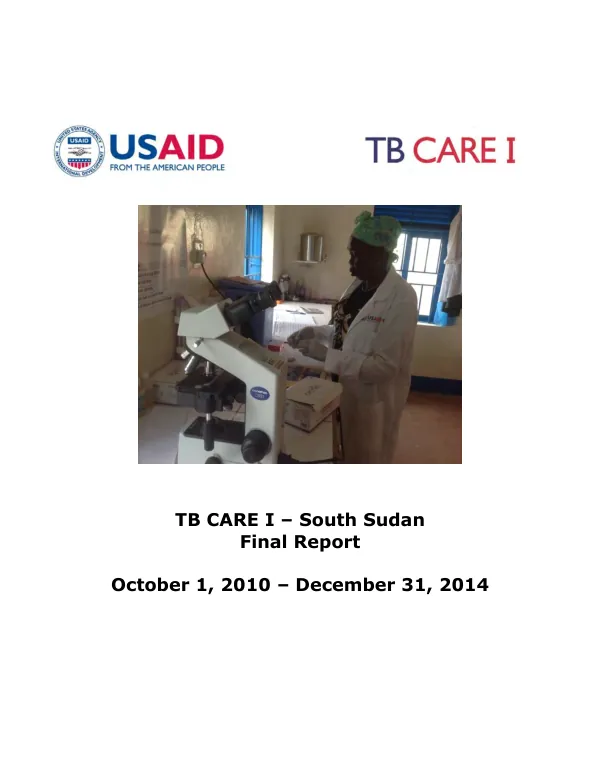
The project was coordinated by Management Sciences for Health (MSH) and implemented from October 1, 2010, to December 31, 2014. TB CARE I received funding from the United States Agency for International Development (USAID) under the terms of cooperative agreement number AID-OAA-A-10-00020. The project focused on four major priority areas: universal and early access of TB treatment, strengthening of laboratory services, health system strengthening, and collaborative TB/human immunodeficiency virus (HIV) activities. South Sudan is one of the youngest nations in the world, with a high maternal mortality rate and under 5 years mortality rate. The country is also experiencing a humanitarian crisis, with over 1 million people displaced and 5 million people facing starvation. TB CARE I achieved several notable results during its implementation. The project increased case notification from 6,411 in 2010 to 8,924 in 2013, which can be attributed to the expansion of directly observed treatment short course (DOTS) centers. In June 2013, 159 community mobilizers were trained to refer suspects and follow-up patients for treatment adherence. Over 43,100 people were sensitized on TB, and 1,249 presumptive TB patients were referred for further evaluation. The project also improved the quality of TB microscopy through the refurbishment and supply of equipment and starter kits for newly established TB diagnostic centers. TB CARE I renovated 10 peripheral and one state-level laboratory, increasing the number of labs performing TB microscopy from 65 in 2010 to 87 in 2014. The laboratory technicians were trained, and 33% of the laboratories were included in the networking of external quality assurance (EQA). TB CARE I also supported the revision of the 2nd National Strategic Plan (NSP) 2012 – 2016 and developed the 3rd NSP 2015 – 2019. The project conducted an epidemiological analysis of the National TB Program (NTP) data to support the NSP review process. TB CARE I partnered with local and international non-governmental organizations (NGOs) to address the delivery of TB/HIV services to displaced and refugee populations. The project supported the establishment of TB/HIV services in Maban (Bunj Hospital) for over 100,000 refugees in Maban. TB CARE I also partnered with International Medical Corps in the protection of civilian site in Juba, where the project is supporting the establishment of TB services at the PoC Hospital. The project sensitized over 10,000 internally displaced persons (IDPs) in Juba on TB and referred over 345 presumptive TB cases for further evaluation. TB CARE I's support to the Global Fund implementation is also notable. The project supported the writing of the concept note to apply for the Global Fund through the new funding model (NFM), which offers an opportunity for the National TB Program (NTP) to access more financial resources to scale up TB service delivery in South Sudan. Overall, TB CARE I made significant contributions to improving TB services in South Sudan, particularly in the areas of case notification, laboratory services, health system strengthening, and collaborative TB/HIV activities. The project's achievements demonstrate its commitment to improving TB services in the country and its ability to adapt to the complex and challenging context of South Sudan.