GOVERNMENT OF BANGLADESH
TB CARE II in Bangladesh: 2 years of Project Support
TB CARE II in Bangladesh is a five-year cooperative agreement launched in April 2011, with the primary objective of strengthening the country's TB control program.
2013 · 2 pages
Sign in to readA free account is required to download.
Abstract
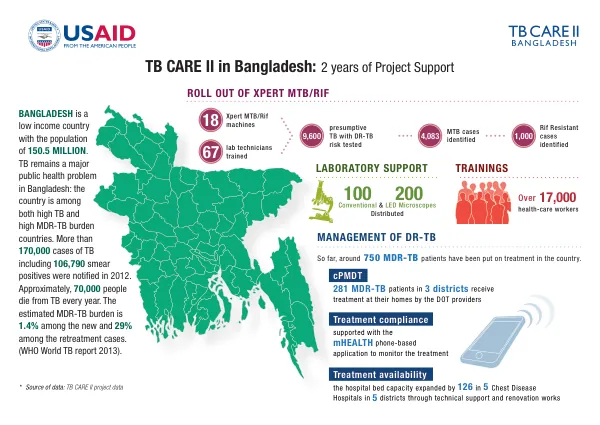
The project is led by the University Research Co., LLC, in partnership with other organizations, including Partners In Health. The initiative is aligned with the National TB Program's strategic objectives and the USAID/Dhaka strategic framework. Bangladesh is a low-income country with a population of 150.5 million, where TB remains a significant public health problem. The country is classified as both a high TB and high MDR-TB burden country. In 2012, over 170,000 cases of TB, including 106,790 smear-positive cases, were notified. Approximately 70,000 people die from TB every year, with an estimated MDR-TB burden of 1.4% among new cases and 29% among retreatment cases. The project has implemented several key interventions to address TB control in Bangladesh. The roll-out of Xpert MTB/RIF machines has been a significant component, with 18 machines distributed and 18 lab technicians trained. This has enabled the identification of 4,083 MTB cases, 1,000 rifampicin-resistant cases, and 9,600 presumptive TB patients with DR-TB risk tested. Additionally, 100 conventional and LED microscopes have been distributed to support laboratory diagnosis. The project has also focused on training and capacity building, with over 17,000 health-care workers receiving training. Management of DR-TB has been a key area of focus, with around 750 MDR-TB patients initiated on treatment. The cPMDT program has been implemented in three districts, providing treatment to 281 MDR-TB patients at their homes through DOT providers. The mHealth phone-based application has been used to support treatment compliance, while hospital bed capacity has been expanded by 126 in five Chest Disease Hospitals through technical support and renovation works. The project's geographic focus is on five districts in Bangladesh, where the TB CARE II partnership is working to strengthen the TB control program. The initiative is expected to contribute to the country's efforts to achieve universal and early access to TB services, programmatic management of drug-resistant TB, and health systems strengthening.
Related documents