FHI
Technical Assistance Report: The WorldFish Center
The WorldFish Center requested technical assistance from mSTAR Bangladesh to operationalize the use of mobile money with field-level staff on the Aquaculture for Income and Nutrition (AIN) project.
2014 · 8 pages
Sign in to readA free account is required to download.
Abstract
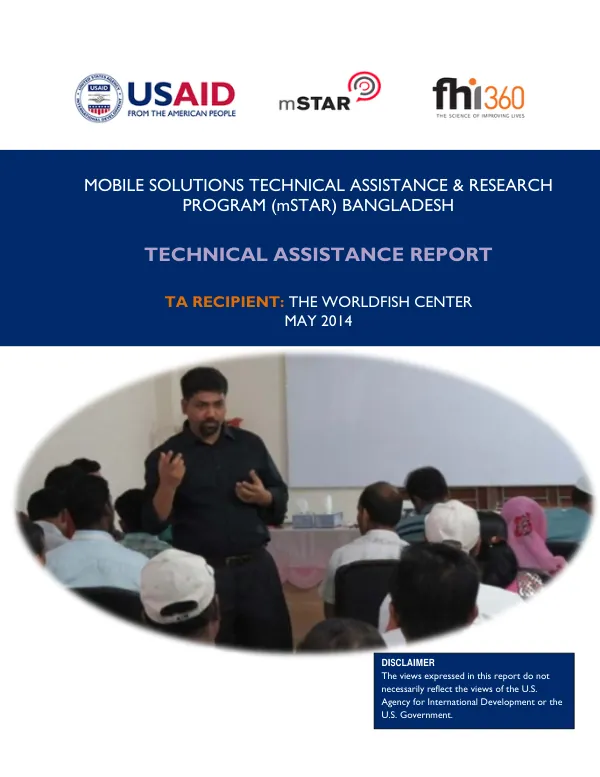
The project aimed to transition from cash to mobile money, but WorldFish faced resistance from some field staff, particularly in the Khulna division. The WorldFish Center head office staff had difficulty conveying the benefits of using mobile money to their field staff. mSTAR Bangladesh provided technical assistance to help WorldFish conduct training workshops in four locations in the Khulna division to address field staff resistance. The workshops aimed to educate participants about the benefits of using mobile phones, particularly for mobile payments. The participants included WorldFish's Extension Facilitators, Field Supervisors, and Technical Specialists. The workshops were facilitated by mSTAR Bangladesh's Team Lead, M. Ataur Rahman, who discussed how new technologies impact people's lifestyles and how mobile phones can be used for multiple purposes beyond making voice calls. The participants primarily came from three groups: Extension Facilitators, Field Supervisors, and Technical Specialists. A total of 139 participants attended the workshops, including 125 Extension Facilitators, 9 Field Supervisors, and 5 Technical Specialists. All participants owned a mobile phone, and more than a quarter of them were already using mobile money. The workshops revealed that participants used their mobile phones for various purposes, including sending and receiving money, accessing the internet, and using social networks. The facilitator invited mobile money users to describe their experience, and participants noted that using mobile money saved them time and money, as they did not need to travel to transfer funds. They also mentioned that relying on middlemen, known as 'dalal', who brought cash to recipients, was troublesome and insecure. Some participants were already aware of the fact that mobiles can be used to send and receive money or airtime credit, although with varying levels of understanding of the process. The TA workshops provided an efficient platform to brainstorm with participants about the usages of mobile money and potential drawbacks of using mobile payments within project interventions. The mSTAR Bangladesh Team Lead trained and guided the entire AIN project team in improving their mobile money-related knowledge, mapping a well-defined process to gradually transition to a cashless system, and defining their roles in that process. The workshops revealed that WorldFish management had not yet figured out a suitable process to pay training allowances to farmers using mobile money, citing low access to mobile phones by farmers, disadvantages to farmers of cashing out of small amounts, mobile money literacy of farmers, and audit documentation. As part of the follow-up process, changes in mobile money transactions for farmer payments will be tracked over the next quarter. The number of farmer-related mobile money transactions is expected to increase gradually due to the mobile money roll-out process. The Extension Facilitators' readiness to adopt mobile money will be observed and included in weekly updates. mSTAR Bangladesh will also invite WorldFish staff to any upcoming and relevant district-level workshops to further increase their capacity, in addition to sharing future knowledge products with the WorldFish team supported during this TA assignment.
Related documents