CHEMONICS
Resilience Programming in Support of Reforestation: Emerging Lessons from Haiti
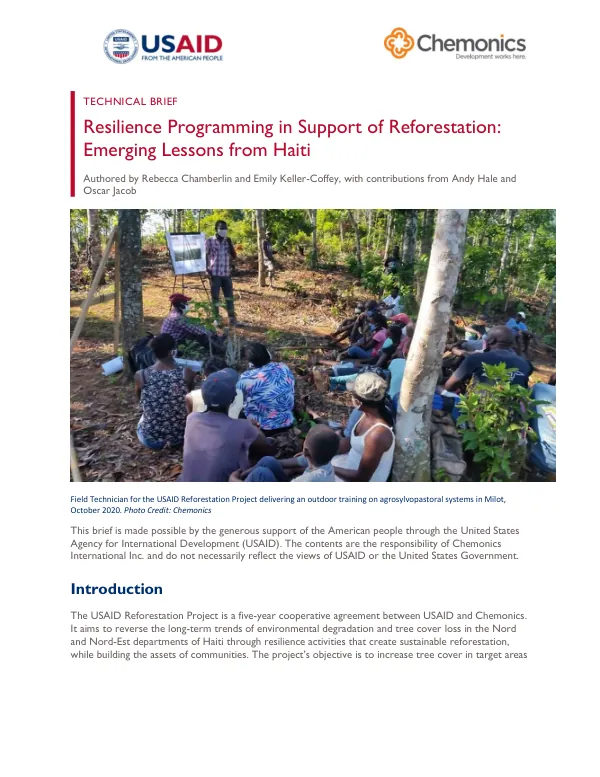
The USAID Reforestation Project in Haiti aims to reverse environmental degradation and tree cover loss in the Nord and Nord-Est departments through resilience activities that create sustainable reforestation.
2021 · 9 pages
Sign in to readA free account is required to download.
Abstract
The project's objective is to increase tree cover in target areas while reducing the threat of deforestation, improving resilience to economic and natural shocks, and improving environmental governance and coordination. The project's approach to measuring and building resilience is based on understanding and building absorptive, adaptive, and transformative capacities. The project has highlighted social capital as a significant influencer of household and community resilience. A comprehensive resilience baseline survey was conducted to understand the aspects of household and community resilience in the project's target communities. The survey instrument consisted of 13 modules and 252 questions, resulting in a potential 160,524 data points. The survey data was disaggregated by elevation, allowing the project to identify differences between those living in highland and lowland areas. The results showed that highlanders had higher levels of social capital, including bonding, bridging, and linking social capital, as well as strong community bonds. For example, more than 70% of highlanders reported participating in one or more groups, such as farmer groups, women's cooperatives, and religious groups, compared to 47% of lowlanders. The project has leveraged the complementary relationship between social capital and resilience to inform and focus programming in the highlands. Capitalizing on the existing social capital in the highlands and building on it when possible is an essential element of the project's approach to reducing deforestation threats. The project builds resilience capacities in various ways, including supporting income generation, facilitating asset protection, and promoting adaptive agriculture techniques. Project activities that build on social capital are already present, drawing on existing networks and connections for community learning, resource sharing, and cooperation in pursuit of mutual benefit among stakeholders. Community-based organizations (CBOs) are a large part of this, as the survey results showed that formal and informal groups exist in all project zones and that households rely on these groups and other social connections for support and opportunities. The project has designed activities to build new social capital to further develop intra-household, community, and stakeholder bonding. These activities promote stronger support systems and information-sharing networks for individuals and communities, supporting individual and community access and participation in income-generating activities and equipping individuals and households to face shocks and stresses. Specific interventions implemented and prioritized based on these findings include promoting adaptive techniques in livestock associations and supporting income generation through forest-friendly animal husbandry. The project's approach to reforestation has been refined to incorporate the lessons learned from the resilience baseline survey. The project's activities are designed to build on the existing social capital in the highlands and to promote stronger support systems and information-sharing networks for individuals and communities. The project's focus on social capital has been instrumental in reducing deforestation threats and improving resilience to economic and natural shocks in the project's target communities.