CORE GROUP
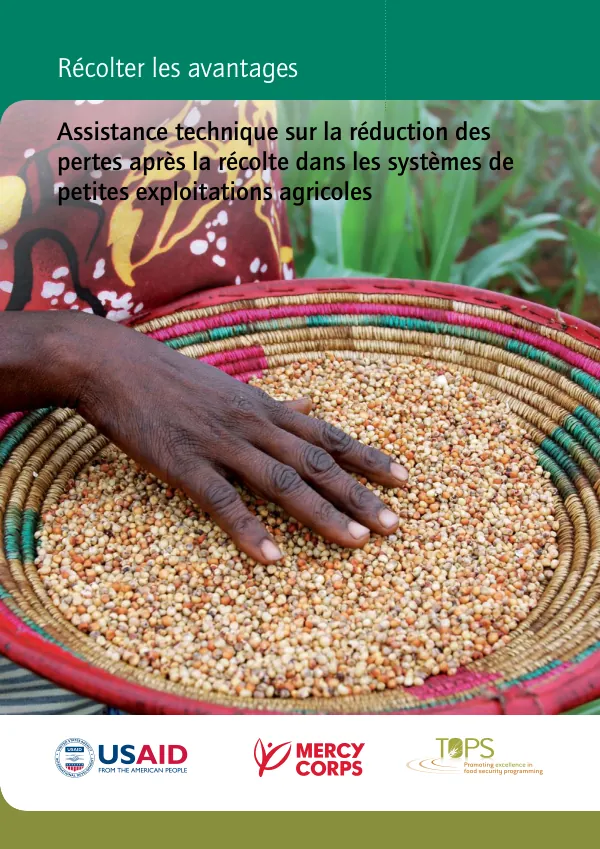
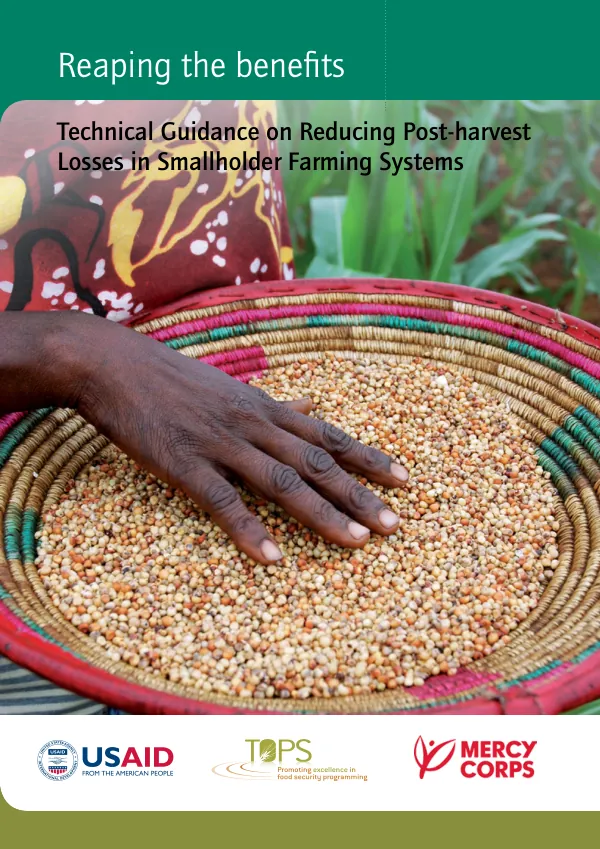
Technical Guidance on Reducing Post-harvest Losses in Smallholder Farming Systems
The Technical and Operational Performance Support (TOPS) Program is a learning mechanism that generates, captures, disseminates, and applies the highest quality information, knowledge, and promising practices in development food assistance programming.
2016 · 20 pages
Sign in to readA free account is required to download.
Abstract
Funded by the USAID/Food for Peace program, TOPS empowers food security implementers and the donor community to make lasting impact for millions of the world's most vulnerable people. The program focuses on reducing post-harvest losses in smallholder farming systems, which can reach 50% in fruits, vegetables, and root crops. These losses can have a major economic impact on household food security and income levels. The quantity and/or quality of loss is affected by practices at all stages of the value chain, including pre-production, production, harvest, transport, assembly, sorting, packing, storage, processing, and distribution. To reduce losses, it is essential to encourage farmers, processors, traders, and transporters to improve practices before, during, and after harvest. This means improved food security and increased profits for farmers. Every gram of food saved at any stage of the value chain is food available for consumption or sale. Promoting the cultivation and consumption of a variety of fruits and vegetables is also crucial to increase dietary diversity and reduce post-harvest losses. The TOPS Program identifies key areas to focus on to reduce post-harvest losses, including seed quality, soil fertility, soil moisture, pests, and diseases. Best practices for seed quality include purchasing seeds from good quality input suppliers, selecting seeds with care, treating seeds with ash or an ash and cow-dung combination, drying seeds to the correct moisture level, and storing seeds in dry, cool containers. Soil fertility can be improved by using soil and water conservation practices, applying organic matter, keeping the soil covered, and avoiding heavy equipment. The program also emphasizes the importance of identifying where key problems lie to help farmers overcome constraints during and after production, get the benefit of support services, and achieve a more efficient farming system that creates more and higher quality food. Problems can be identified from a number of sources, including value-chain actors, agricultural and market literature, and websites and databases. The TOPS Program provides technical guidance on reducing post-harvest losses in smallholder farming systems, including best practices for reducing food loss, improving seed quality, and maintaining soil fertility. The program aims to stimulate the use of good agricultural practices to reduce post-harvest losses and improve household food security and smallholder farmer profits. The value chain is a critical component of reducing post-harvest losses, and the TOPS Program emphasizes the importance of improving practices at each stage of the value chain, including pre-production, production, harvest, transport, assembly, sorting, packing, storage, processing, and distribution. By improving practices at each stage of the value chain, farmers can reduce post-harvest losses and improve their food security and income levels. The TOPS Program provides a range of resources and tools to support the reduction of post-harvest losses, including training manuals, guides, and online resources. The program also emphasizes the importance of collaboration and coordination among value-chain actors to reduce post-harvest losses and improve household food security and smallholder farmer profits. Overall, the TOPS Program is a critical component of reducing post-harvest losses in smallholder farming systems, and its technical guidance and resources are essential for improving household food security and smallholder farmer profits. By improving practices at each stage of the value chain and reducing post-harvest losses, farmers can increase their food security and income levels, and improve their overall well-being.
Related documents