USAID DEC
Technical Vocational Education and Training Strengthening for At-Risk Youth (TVET SAY) Baseline Study
Sign inCREATIVE ASSOCIATES INTERNATIONAL INC.
Technical Vocational Education and Training Strengthening for At-Risk Youth (TVET SAY) Baseline Study
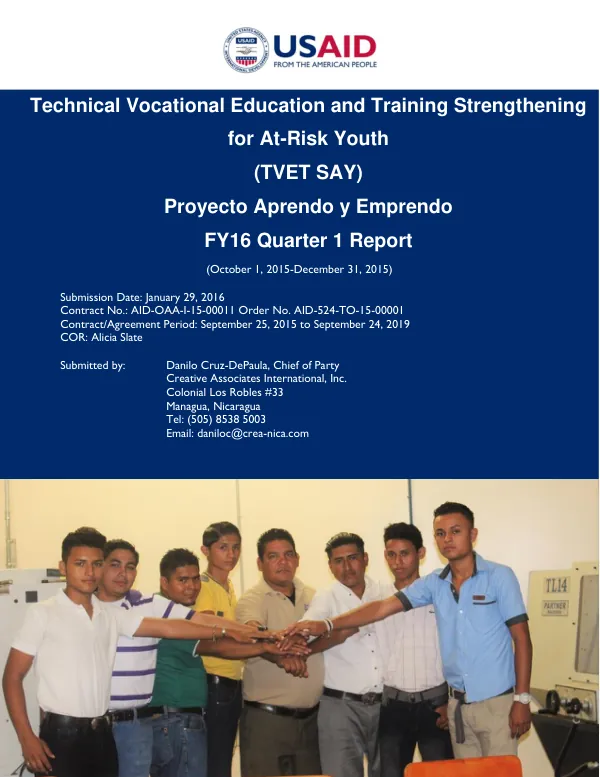
The Technical Vocational Education and Training Strengthening for At-Risk Youth (TVET SAY) project, also known as "Aprendo y Emprendo," is a four-year effort focused on private technical and vocational education (TVET) institutions in Nicaragua.
2016 · 96 pages
Sign in to readA free account is required to download.
Abstract
The project aims to provide technical education certificates and formal employment to youth with a minimum level of educational attainment, as well as support self-employment or commitment to address a need for products and services in their communities. The Baseline Study for the TVET SAY project was conducted using a sample of 391 youth between the ages of 14-29 years in three categories: current students, graduates from six technical vocational education centers, and youth not participating in the educational system in the municipalities of Bluefields, Bilwi, and Nueva Guinea in the Caribbean Coast of Nicaragua. The sample represents youth at eleven centers, totaling 3,325 potential project beneficiaries. Quantitative and qualitative data collection and analysis techniques were used to generate initial values for the 19 project indicators. The students in the centers range in age from 15-19 years old, with 72% of enrolled students between the ages of 15-19 years being male and 28% being female. This gender gap extends beyond enrollment to job placement, with women experiencing significantly lower job placement and limited access to capital. Disaggregated by ethnic identity, members of the Mestizo group have the greatest representation in the sample, followed by Garifuna, Miskito, and Rama. Risk factors differ by ethnicity, and participants suffer from a significant prevalence of poverty, parental abuse, and parental migration from the Caribbean Coast. These same groups express hopelessness and fail to maintain a positive outlook for their lives. Out-of-school youth living in the municipalities of Nueva Guinea, Bilwi, and Bluefields recognize that opportunities for technical education exist, but only 27% of those youth have a positive perception of technical education, and 37% have a positive perception of work training. Youth from Bilwi express the most negative perceptions of technical education and work training, while Bluefields youth express the most positive perceptions, and Nueva Guinea youth are somewhere in the middle. The TVET SAY project aims to address these challenges by providing technical education and training to at-risk youth, with a focus on private TVET institutions. The project will work to strengthen the capacity of these institutions, improve the quality of technical education, and increase access to employment opportunities for at-risk youth. The project will focus on three key components: TVET center network development, capacity building of private TVET centers, and public perceptions of TVET in the Caribbean Coast. The project will also provide scholarships and employment support for at-risk youth from the Caribbean Coast. The Baseline Study provides a comprehensive understanding of the challenges faced by at-risk youth in Nicaragua and the opportunities for technical education and training. The study highlights the need for a comprehensive approach to address the challenges faced by at-risk youth, including poverty, lack of access to education and employment opportunities, and limited access to capital. The TVET SAY project aims to make a significant impact on the lives of at-risk youth in Nicaragua by providing them with the skills and knowledge needed to secure employment and improve their socio-economic status. The project will work to strengthen the capacity of private TVET institutions, improve the quality of technical education, and increase access to employment opportunities for at-risk youth. The project will also work to address the challenges faced by out-of-school youth, including limited access to technical education and training, and negative perceptions of technical education and work training. The project will provide scholarships and employment support to at-risk youth from the Caribbean Coast, with a focus on improving their socio-economic status and increasing their access to employment opportunities.
Related documents