USAID DEC
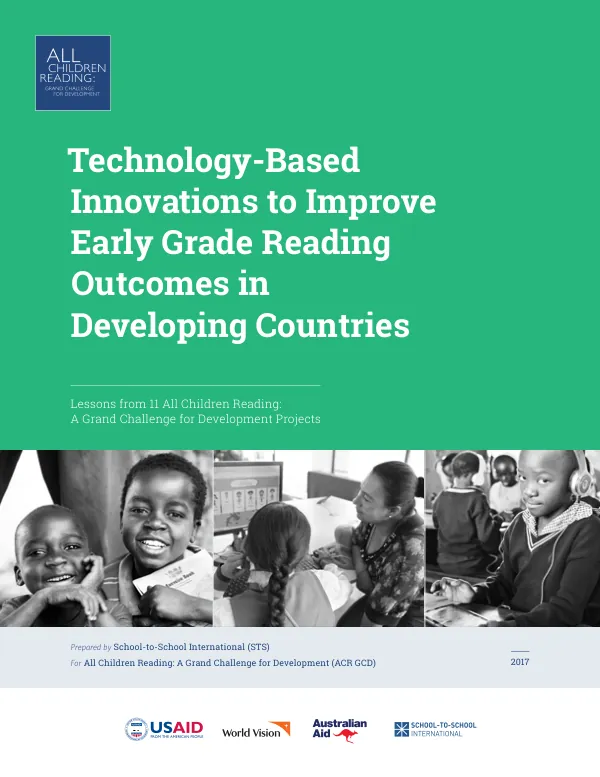
Technology-Based Innovations to Improve Early Grade Reading Outcomes in Developing Countries
Sign inCATHOLIC RELIEF SERVICES ORGANIZATION
Technology-Based Innovations to Improve Early Grade Reading Outcomes in Developing Countries
The All Children Reading: A Grand Challenge for Development (ACR GCD) is an ongoing series of competitions that leverage science and technology to source, test, and disseminate scalable solutions to improve literacy skills of early grade learners in developing countries.
2017 · 32 pages
Sign in to readA free account is required to download.
Abstract
ACR GCD Round 2, which started in 2014 and continued through 2018, sought technology-based innovations to improve early grade reading outcomes in developing countries. Through a grant competition, 142 innovators from ten countries were selected to implement technology-based projects concentrating on three focus areas: mother tongue instruction and reading materials, family and community engagement, and children with disabilities. Grantees supported students' mother tongue language development through the promotion of classroom instruction approaches or the creation of reading materials in students' mother tongue. They incorporated a wide range of technologies into their projects, including hardware such as feature phones, smartphones, computers, tablets, and radio, or various assistive devices to support students who have low vision or are blind. Grantees also provided literacy content to beneficiaries through diverse software technologies, including mobile applications, websites, and others. ACR GCD Round 2 increased its focus on the assessment of early grade reading skills to understand the ability of technology-based innovations to improve the literacy skills of early grade learners. School-to-School International (STS) collaborated with each grantee to develop their research study design, including advising on sampling methods, conducting Early Grade Reading Assessments (EGRA) at baseline and endline, and providing technical assistance on each grantee's monitoring and evaluation (M&E) and fidelity of implementation activities. The projects tested a wide range of technologies and implementation approaches to address students' reading needs at and outside of school. Across projects, and regardless of focus area, grantees supported students' mother tongue language development through the promotion of classroom instruction approaches or the creation of reading materials in students' mother tongue. For example, students in rural Zambia received text message stories and comprehension questions on their parents' or caretakers' phone in their mother tongue, ciNyanja. Students in India who have low vision or are blind were provided accessible reading materials in their mother tongue, Marathi. The projects also implemented various interventions to improve reading outcomes, including teacher training programs, infrastructure development, and market linkage facilitation. For example, teachers in Lesotho received equipment to produce braille materials, and students in Cambodia read leveled e-books in Khmer on the SmartBooks application and played corresponding quizzes and questions. The projects also provided literacy content to beneficiaries through diverse software technologies, including mobile applications, websites, and others. The projects reached a significant number of children, with a total of 142,000 children reached across all projects. The projects also received significant funding, with a total of $10 million awarded to the grantees. The projects demonstrated the potential of technology-based innovations to improve early grade reading outcomes in developing countries, and the findings from the projects can inform the development of future interventions to improve literacy skills in these countries.