USAID
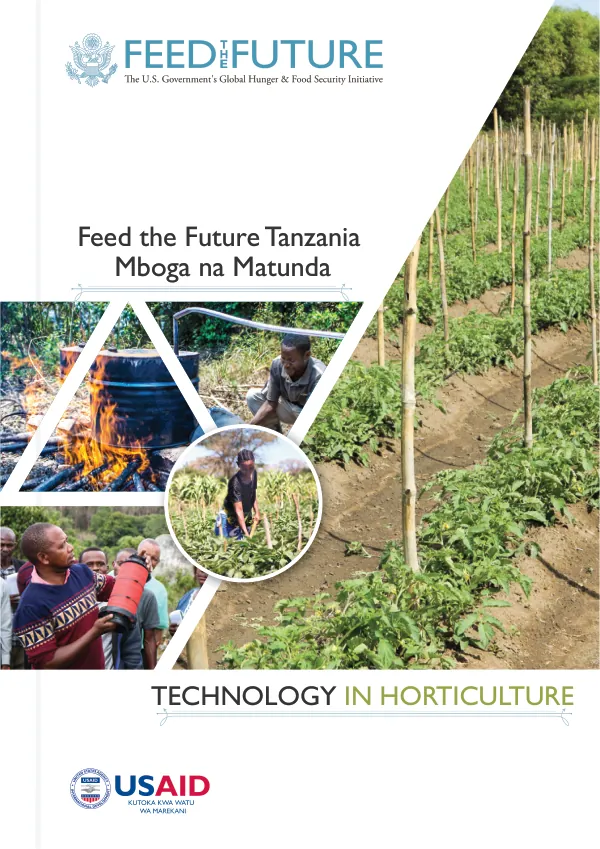
Technology in Horticulture
Horticulture has a commercial bias due to the levels of investments, required technologies, and specific knowledge needed to make a success.
2018 · 10 pages
Sign in to readA free account is required to download.
Abstract
The sector is very diverse, with many different crops and cropping systems, which means the necessary levels of investments, technologies, and knowledge vary. There is no comparison between a 4-week crop of amaranth and a 6-month crop of indeterminate tomatoes grown hydroponically in a greenhouse. Farmers need to be selective when it comes to technologies, which have costs associated with them. They should not utilize technologies that are too simple and lead to lowered profits or commit to technologies that are expensive or complicated to use without having the required knowledge or resources. Technologies also have impacts that are often dependent on the existing use of other technologies and Good Agricultural Practices. Some technologies need other technologies and management practices for them to fully realize their potential. For instance, hybrid seeds require sterile planting medium, seedling trays, and proper plant spacing and crop management for them to generate improved yields. Without the right foundation, these technologies will not generate improved yields and will instead reduce profits. The bulletin gives a brief summary of the range of technologies and management practices that are important in horticulture. Some detail is given on each, and an attempt is made to group them into categories based on their expense and ease of use. Pre-Plant & Transplant technologies include certified, commercially produced, open-pollinated (OP) varieties, which are clean of pests and diseases and have decent uniformity and yield. Hybrid varieties give higher yields and have tolerances to pests and diseases. Plastic or Styrofoam trays are used to produce strong seedlings, which are uniform with a good root structure that promotes quick growth. Commercial planting medium, made from local materials, is a cheaper option but needs to be sterilized using a barrel sterilizer. Many of the soils in the Southern Highlands are acidic, and liming the soil using calcium increases the pH and nutrient uptake. Sorghum is planted around the edges of a field before the crop is transplanted, providing a barrier against insect pests and acting as a windbreak. Post-Plant & Harvest technologies include even spacing of plants to fully utilize water and fertilizer in the field. A simple stick with markings showing the planting distance for a crop helps ensure proper spacing. Seedlings often struggle when transplanted into a field, but their establishment is helped by first placing a cupful of water with a little bit of dissolved phosphorus fertilizer in each planting hole. Plants only feed on nutrients in solution, and soluble fertilizers allow for accurate placement in the root zone and efficient use of nutrients by the plants. Drip irrigation allows for efficient use of water and delivery of soluble fertilizers to plants. Proper management and maintenance are very important. Many crops, such as tomatoes, cucumbers, and peppers, need to be staked for optimal growth. Local stakes are easier to source but are more labor-intensive and do not last as long as long-term stakes and twine. Key agrochemicals include fungicides, insecticides, and herbicides that are not traditionally used by farmers. Integrated Pest Management (IPM) prepares farmers for pest and disease problems and early action. Crop protection should focus on avoiding pest and disease problems and then on early detection and control. A reliance on pesticides is not recommended for many reasons. Irrigation needs constant management, and frequency and amounts of applied water should be based on the type of crop, growth stage, soil type, and climatic conditions. A well-irrigated crop responds well to fertilizer applications, and fertilizers are expensive, so farmers should understand the nutrient needs of their crops for efficient use of fertilizers. Soil tests are an important tool in determining soil conditions and nutrient levels. The Feed the Future Mboga na Matunda activity recommends the eventual adoption of all these technologies and practices but recommends that a farmer should only adopt what is currently affordable based on their business plan. A farmer with limited resources should focus on the fundamentals of commercial farming, which are the technologies in the lower left-hand corner of the chart. Even with limited resources, a farmer should make an effort to increase their knowledge, including making business planning and Integrated Pest Management standard management practices. After that, farmers should adopt technologies as they become more affordable and their knowledge allows.