USAID DEC
Test de stabilité du sol
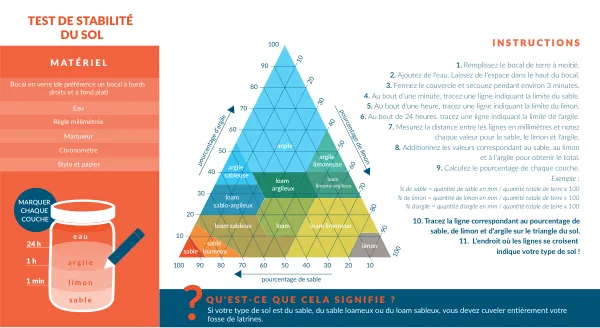
The test for soil stability involves a series of steps to determine the composition of the soil.
2 pages
Sign in to readA free account is required to download.
Abstract
The process begins with filling a glass container to a certain level with soil, leaving space at the top. Water is then added, and the container is sealed and shaken for approximately three minutes. After one minute, a line is drawn to indicate the limit of the sand layer. Following this, a line is drawn after one hour to indicate the limit of the silt layer, and another line is drawn after 24 hours to indicate the limit of the clay layer. The distance between these lines is measured in millimeters and recorded for each layer. The total distance is then calculated by adding the values for sand, silt, and clay. The percentage of each layer is determined by dividing the value for each layer by the total distance and multiplying by 100. This process results in a percentage of sand, silt, and clay, which can be used to classify the soil type. The classification of the soil is based on the percentage of sand, silt, and clay. A soil with a high percentage of sand is classified as sandy, while a soil with a high percentage of clay is classified as clayey. A soil with a balanced mixture of sand, silt, and clay is classified as loam. The classification of the soil is critical in determining the necessary construction methods for a latrine pit. The stability of the soil is also influenced by other factors, including the presence of layers, previous excavation, and the type of soil. Sols argileux, or clayey soils, may require additional consideration due to their potential to change stability with changes in humidity. Sols en couches, or layered soils, may also require special attention due to the potential for the "weakest link" to fail and cause the pit to collapse. Sols précédemment excavés, or soils that have been previously excavated, may also be more prone to failure due to the disturbance of the soil structure. The classification of the soil and the consideration of these additional factors are essential in determining the necessary construction methods for a latrine pit. The table provided lists the types of soil that require full excavation and those that do not. Sols non consolidés, or non-consolidated soils, and terre remblayée, or filled soil, are examples of soils that require full excavation. On the other hand, sables mous et graviers, or loose sand and gravel, and roches sédimentaires très consolidées, or highly consolidated sedimentary rocks, do not require full excavation. In cases where there is doubt about the soil type, it is recommended to excavate the entire pit. This approach ensures the stability and safety of the latrine pit. The classification of the soil and the consideration of these additional factors are critical in determining the necessary construction methods for a latrine pit.