USAID
The 5Rs Framework in the Program Cycle
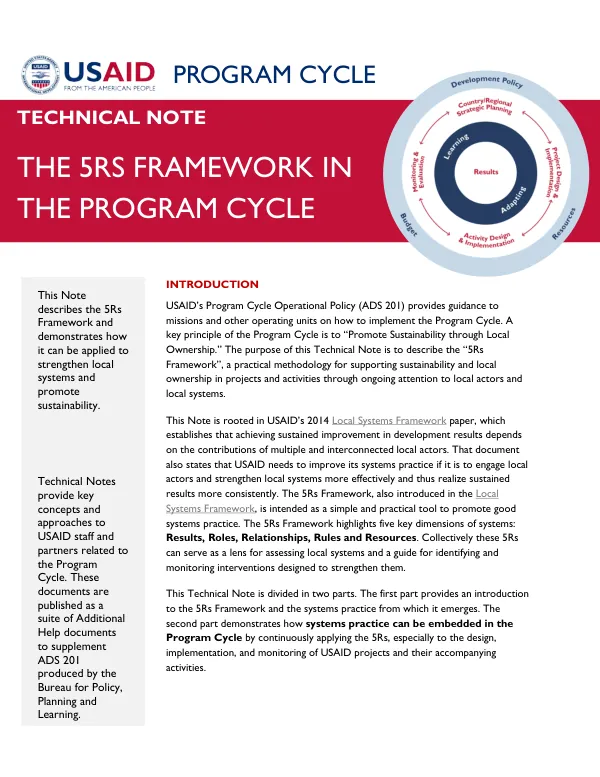
The 5Rs Framework is a practical methodology for supporting sustainability and local ownership in projects and activities through ongoing attention to local actors and local systems.
2016 · 20 pages
Sign in to readA free account is required to download.
Abstract
This framework is rooted in USAID's 2014 Local Systems Framework paper, which establishes that achieving sustained improvement in development results depends on the contributions of multiple and interconnected local actors. The 5Rs Framework highlights five key dimensions of systems: Results, Roles, Relationships, Rules, and Resources. Collectively, these 5Rs can serve as a lens for assessing local systems and a guide for identifying and monitoring interventions designed to strengthen them. The framework provides focus to each of the four phases of systems practice: listening to the system, engaging the system, discovering the actual effects of interventions, and adapting interventions in response to discoveries. Systems practice is an ongoing process that involves working with local systems effectively. This requires a willingness to embrace the concepts and tools that comprise systems thinking and a set of commitments and values that guide the way of working with systems. The 5Rs Framework helps to identify key aspects of a system that are important for understanding how the system functions and important as leverage points for introducing change. The framework emphasizes the importance of understanding the interactions between actors, resources, and rules that produce desired results. It also highlights the need to determine the appropriate dimensions of a system, which can be challenging, especially when using a clearly articulated result as the focal point. The framework provides a stylized depiction of a system, which includes interactions, roles, relationships, resources, and rules. Sustainability in a local system depends on realizing results that systems-actors truly value. If the results are not valued or fail to materialize, then systems actors will reduce resource inflows, which may undermine the viability of that system. Applying the 5Rs Framework to the program design process can help develop interventions that are informed by local context and more likely influence the system to produce valued results that are sustained over time. The 5Rs Framework is intended to be a practical tool to promote good systems practice. It is designed to be applied to the design, implementation, and monitoring of USAID projects and their accompanying activities. The framework is also intended to be used in conjunction with other systems tools and concepts, such as the Local Systems Toolkit, which provides additional resources and support for USAID staff interested in learning more about systems practice and its application.