USAID DEC
The Champion Communes Approach: Improving communities’ capacity to manage health activities
Sign inJSI RESEARCH & TRAINING INSTITUTE, INC
The Champion Communes Approach: Improving communities’ capacity to manage health activities
The Champion Communes Approach was a key component of the Madagascar Community-Based Integrated Health Program (CBIHP), locally known as MAHEFA.
2016 · 4 pages
Sign in to readA free account is required to download.
Abstract
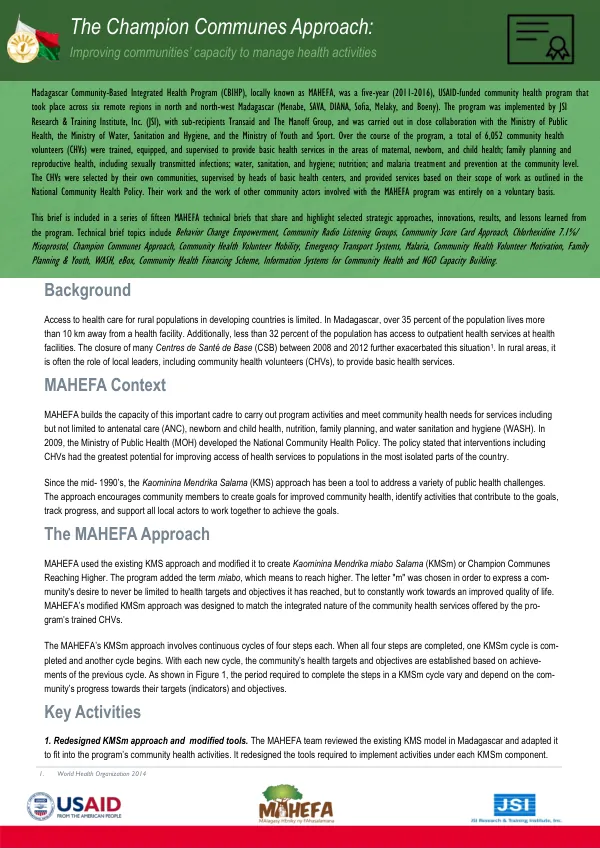
This five-year program, funded by USAID and implemented by JSI Research & Training Institute, Inc., aimed to improve communities' capacity to manage health activities in six remote regions of north and north-west Madagascar. The program built on the existing Kaominina Mendrika Salama (KMS) approach, which encouraged community members to create goals for improved community health, identify activities that contribute to the goals, track progress, and support all local actors to work together to achieve the goals. MAHEFA modified the KMS approach to create Kaominina Mendrika miabo Salama (KMSm), or Champion Communes Reaching Higher, which added the term miabo, meaning to reach higher, to reflect a community's desire to constantly work towards an improved quality of life. The MAHEFA's KMSm approach involved continuous cycles of four steps: introducing the concept to community leaders, training community health volunteers (CHVs) on the approach, developing a health plan with community members, and monitoring progress against targets. Each cycle had a minimum percentage required for a commune to be declared a Champion Commune for that year. By the end of February 2016, all 279 MAHEFA communes completed their third KMSm cycle, achieving at least 80 percent of their health targets, and 131 communes completed their fourth cycle, achieving 85 percent of their targets. The KMSm approach was designed to match the integrated nature of the community health services offered by the program's trained CHVs. The approach involved continuous cycles of four steps, with each cycle building on the previous one. The program's trained CHVs played a crucial role in implementing the KMSm approach, providing basic health services in areas such as maternal, newborn, and child health; family planning and reproductive health; water, sanitation, and hygiene; nutrition; and malaria treatment and prevention. The MAHEFA program trained a total of 6,052 community health volunteers (CHVs) to provide basic health services in the program areas. The CHVs were selected by their own communities, supervised by heads of basic health centers, and provided services based on their scope of work as outlined in the National Community Health Policy. The program's approach to training and supervising CHVs was critical to its success, as it enabled the CHVs to provide high-quality services to the communities they served. The MAHEFA program's results were impressive, with all 279 communes completing their third KMSm cycle and achieving at least 80 percent of their health targets. The program's success was due in part to its ability to engage community members in the planning and implementation of health activities, which helped to build ownership and commitment to the program's goals. The program's use of the KMSm approach also helped to ensure that health activities were integrated and coordinated, which improved the overall effectiveness of the program. The MAHEFA program's experience with the KMSm approach has important implications for other community-based health programs. The approach's focus on community engagement, ownership, and participation can help to build a strong foundation for health programs, even in challenging environments. The program's use of continuous cycles of four steps can also help to ensure that health activities are integrated and coordinated, which can improve the overall effectiveness of the program.
Related documents