JSI RESEARCH & TRAINING INSTITUTE, INC
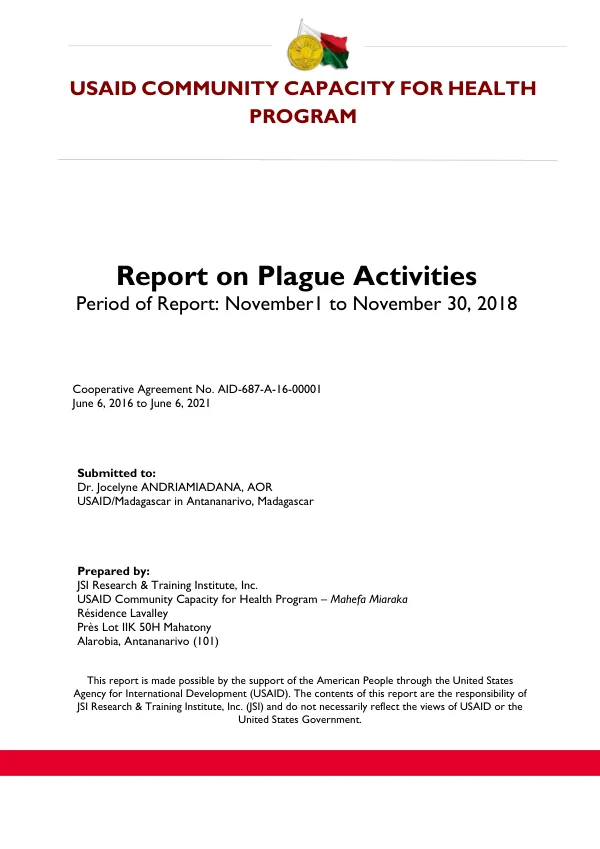
USAID Community Capacity for Health Program Report on Plague Activities
The USAID Community Capacity for Health Program, locally known as Mahefa Miaraka, is a five-year community-based integrated health program funded by the United States Agency for International Development (USAID).
2018 · 9 pages
Sign in to readA free account is required to download.
Abstract
The Program operates in a total of 4,885 fokontany, 456 communes, and 34 districts in the Analanjirofo, Boeny, DIANA, Melaky, Menabe, SAVA, and Sofia regions. The Program has the potential to provide services to approximately 6.1 million people, or 23.3 percent of the country's total population. The Program's main objective is to strengthen the health system and health policies in Madagascar. To achieve this goal, the Program provides tools and capacity-building training to approximately 10,000 Community Health Volunteers (CHVs). The Program also works with national and local government actors to strengthen the health system and health policies. The Program's expertise in working at every level of Madagascar's health care landscape makes it uniquely suited to partner in the fight against the plague. In 2018, the plague season started in September, and the Program team, along with other technical and financial partners, took an active part in the Government of Madagascar's plague preparation and response efforts at the national, regional, district, and commune levels. The Program team participated in eight meetings organized by the plague crisis units, the Division of Health Promotion (DPS), USAID, and WHO for coordination of logistics. In addition, the Program trained 2,641 people, including 47 commune leaders, 340 fokontany heads, 2,059 community health volunteers, and 195 health providers, on plague prevention and response. The Program's plague response activities included training community health volunteers and fokontany heads according to the Ministry of Health's training curriculum. The objective of the trainings was for community actors to prevent plague epidemics and break the chain of transmission to reduce the spread of the plague outbreak. The trainings provided necessary information and education to important stakeholders to coordinate their efforts in preparation and response for the anticipated epidemic, especially at the community level. The Program also contributed technical and financial assistance in response to the plague epidemic. The Program provided financial support to the Ministry of Health, Directorate of Disease Control and Epidemiological Surveillance (DVSSE), for the training of Regional, District staff on the electronic surveillance and reporting system. The Program's staff participated in the national trainers of trainers training on the new treatment protocol of plague. In the Melaky Region, a health check point (barrage sanitaire) was established on November 22 at Beravina in Morofenobe District as a preventative measure against the plague and also the measles epidemic. The regional CCH team supported the establishment of the health check point and provided technical assistance to the local health authorities. The Program's efforts in plague response were focused on training community health volunteers and fokontany heads, reporting of suspected plague cases to CSB, and providing technical and financial assistance in response to the plague epidemic. The Program's activities were coordinated with other technical and financial partners, including the Ministry of Health, USAID, and WHO, to ensure a comprehensive and effective response to the plague epidemic.