USAID DEC
Community Emergency Transport Systems: Using transport to improve access to health services in rural Madagascar
Sign inJSI
Community Emergency Transport Systems: Using transport to improve access to health services in rural Madagascar
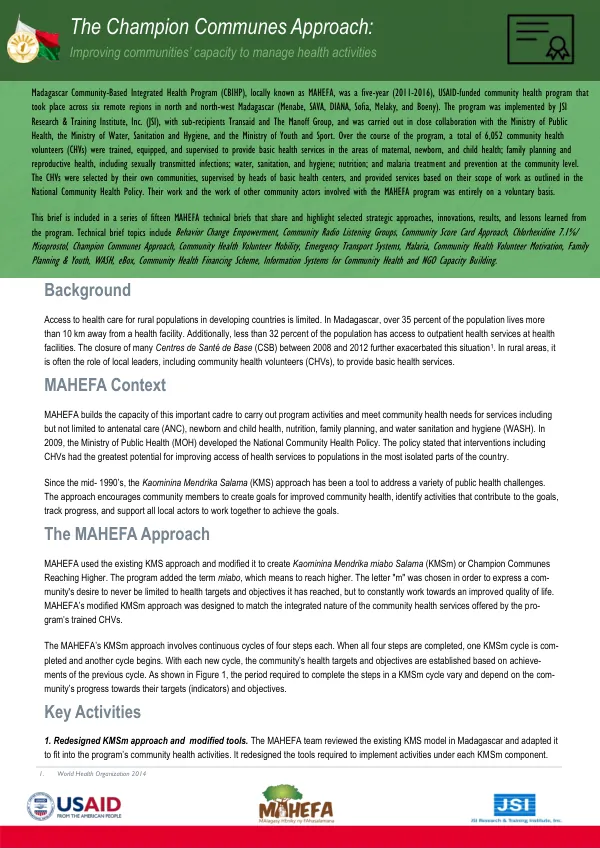
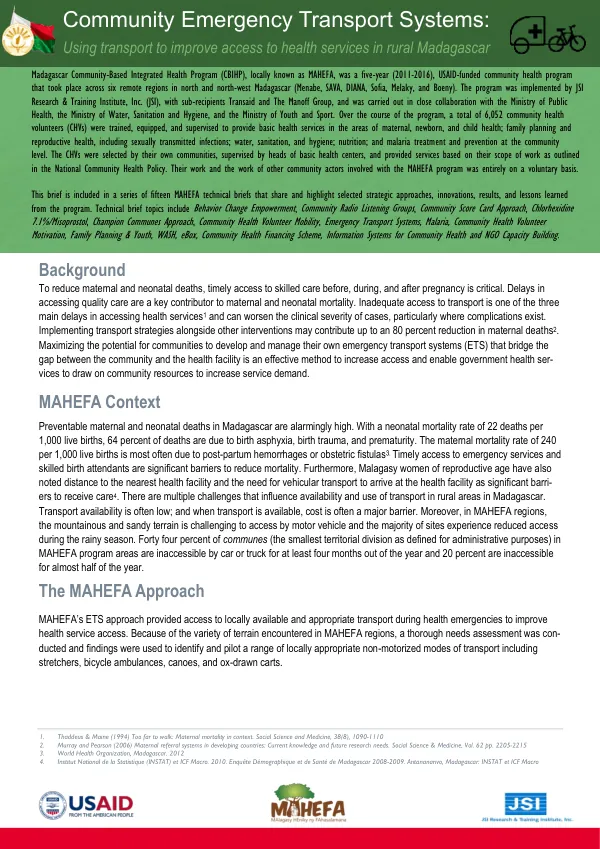
Emergency Transport Systems: Using Transport to Improve Access to Health Services in Rural Madagascar The community health program, MAHEFA, was a five-year initiative implemented across six remote regions in north and north-west Madagascar.
2016 · 4 pages
Sign in to readA free account is required to download.
Abstract
The program aimed to improve access to health services, particularly for maternal, newborn, and child health, by establishing community-based emergency transport systems (ETS) that bridge the gap between the community and the health facility. Preventable maternal and neonatal deaths in Madagascar are alarmingly high, with a neonatal mortality rate of 22 deaths per 1,000 live births and a maternal mortality rate of 240 per 1,000 live births. Timely access to emergency services and skilled birth attendants are significant barriers to reducing mortality. Malagasy women have noted distance to the nearest health facility and the need for vehicular transport to arrive at the health facility as significant barriers to receiving care. A comprehensive transport needs assessment was conducted in 2012, which included interviews with community members and identified the challenges of transport availability and cost in rural areas. The assessment also highlighted the need for locally available and appropriate transport modes, such as bicycle ambulances, canoes, and ox-drawn carts. The MAHEFA ETS approach provided access to locally available and appropriate transport during health emergencies to improve health service access. A needs assessment was conducted in 2012, and findings were used to pilot a range of non-motorized transport modes. The program established links between ETS groups, community health insurance schemes, and the eBox activities to provide other avenues of support and funding for repairs and maintenance. Key activities included conducting a needs assessment, manufacturing initial fleets, conducting pilot activities, and expanding to other regions. The program also established a workshop for construction of emergency transport, a redesign workshop to ensure the quality of subsequent production, and a workshop to further build the production of ETS expertise of local partners. The ETS activities were implemented in five regions, with a total of 186 management committees, supervisors, and riders trained. The program also established a system of logbooks for drivers that were consolidated and sent to the community management committees for aggregation and reporting. Results of the ETS activities in the MAHEFA program area show that the ETS activities were implemented in 15 communes, with a total of 186 management committees, supervisors, and riders trained. The program also established a system of logbooks for drivers that were consolidated and sent to the community management committees for aggregation and reporting. The ETS activities in the MAHEFA program area show that the program was able to establish a system of emergency transport that improved access to health services in rural Madagascar. The program also established a system of logbooks for drivers that were consolidated and sent to the community management committees for aggregation and reporting.