USAID DEC
The complete mitochondrial genome of Corydoras nattereri (Callichthyidae: Corydoradinae)
Sign inUSAID DEC
The complete mitochondrial genome of Corydoras nattereri (Callichthyidae: Corydoradinae)
Corydoradinae are a species-rich group of armored freshwater catfishes that inhabit streams, rivers, and floodplains throughout South America.
2016 · 9 pages
Sign in to readA free account is required to download.
Abstract
This group, together with the Callichthyinae, comprises the Callichthyidae, a family of catfishes diagnosed by the presence of two series of bony plates on the sides of the body and one pair of barbels at lips junction. The Corydoradinae comprises 227 nominal taxa and 188 valid species, assigned to the Aspidoras Ihering, 1907, Corydoras Lacépède, 1803, and Scleromystax Gunther, 1864. Corydoras is the most species-rich genus of catfishes with over 160 described and nearly as many undescribed species. Corydoras nattereri, a species of mailed catfishes from southeastern Brazil, is a widespread species with a geographic range of about 1,350 km, encompassing numerous isolated coastal river drainages. This species is known to form a pair of color mimics with Scleromystax prionotos, where their distribution overlaps. Significant variability has been found among various populations of C. nattereri, with Oliveira et al. (1990) identifying three different cytotypes among these populations, that differ in number of chromosomes (2n numbers of 40, 43 and 44), suggesting that more than one species is represented by the taxon. The complete mitochondrial genome of Corydoras nattereri was reconstructed using next-generation sequencing techniques. The mitogenome was assembled using mitochondrial transcripts from the liver transcriptomes of three individuals, and produced a circular DNA sequence of 16,557 nucleotides encoding 22 tRNA genes, two rRNA genes, 13 protein-coding genes, and two noncoding control regions (D-loop, OrigL). Phylogeographic analysis of closely related sequences of Cytochrome Oxydase C subunit I (COI) demonstrates high diversity among morphologically similar populations of C. nattereri. Corydoras nattereri is nested within a complex of populations currently assigned to C. paleatus and C. ehrhardti. The mitogenome structure of C. nattereri was analyzed, and an insertion of 21 nucleotides between the ATPase subunit-6 and COIII genes was found. This insertion may represent a phylogenetically informative character associated with the evolution of the Corydoradinae. The complete mitogenome of C. nattereri provides a significant increment in DNA data available for phylogenetic studies of the Corydoradinae. This study highlights the importance of using complete mitochondrial sequence data for phylogenetic analysis, particularly in species-rich groups like the Corydoradinae. The specimens used for the study were collected in the rio Suruí, at the Santo Aleixo district, Magé, Rio de Janeiro, Brazil. The fish were deposited at the Museu Nacional, Rio de Janeiro, UFRJ, and tissues from three individuals were preserved in ethanol and RNALater. Total RNA was extracted from the liver tissue, and three individual cDNA libraries were constructed using the TruSeq RNA Sample kit v.2 (Illumina). Libraries were accessed for quality and quantity, and two separated runs were performed in an Illumina HiSeq 2500 using the TrueSeq SBS kit v.3 (Illumina). Raw Illumina data were demultiplexed using the BCL2FASTQ software (Illumina), and reads were trimmed for Illumina adaptors by Trimmomatic (Bolger et al., 2014). Cleaned reads from the three individual fish were used for the de novo assembly of transcriptomes using the default parameters of Trinity (v. 2.0.2) (Haas et al., 2013). Mitochondrial genomes were assembled using the mitochondrial transcripts from the liver transcriptome, following the approach described by Moreira et al. (2015a, 2015b).
Related documents
Documents in this collection
 2016
2016USAID DEC
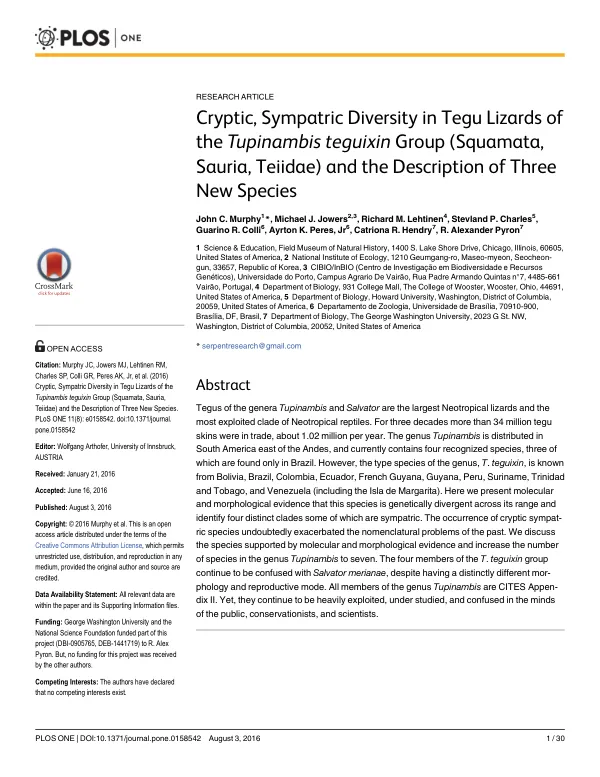
Cryptic, Sympatric Diversity in Tegu Lizards of the Tupinambis teguixin Group (Squamata, Sauria, Teiidae) and the Description of Three New Species
Open record 2023
2023USAID DEC